EPISODE 6: Strategic Assertion and Systems Integration (1998–2008) from Engineers Heaven's Idea / Prospect
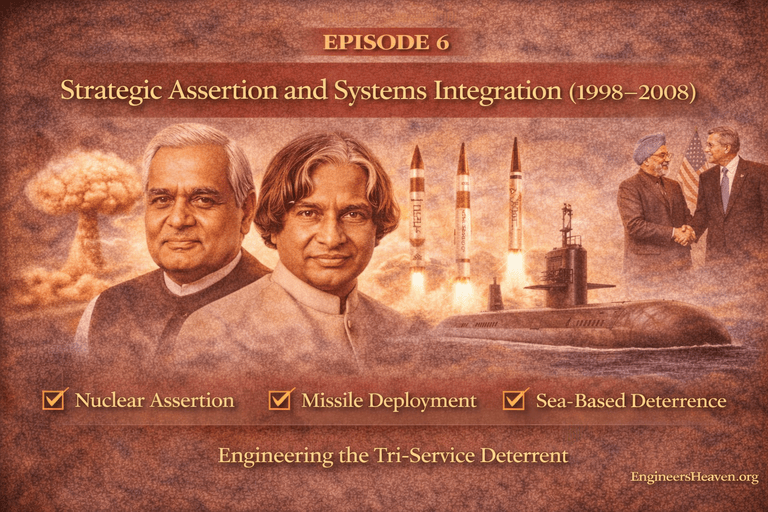 EPISODE 6 Strategic Assertion and Systems Integration (1998–2008)
11 May 1998 — Pokhran-II.
India moved from nuclear ambiguity to declared nuclear weapons state.
This episode is about transition from capability to doctrine.
1️⃣ Pokhran-II: The Overt Declaration 11 & 13 May 1998 – Five Nuclear Tests(Operation Shakti)
Prime Minister:
Atal Bihari Vajpayee
Scientific Leadership:
A. P. J. Abdul Kalam
R. Chidambaram
India tested:
Fission device
Thermonuclear design
Sub-kiloton devices
Immediate consequences:
U.S. sanctions (Glenn Amendment)
Japanese financial restrictions
Multilateral diplomatic pressure
But unlike 1974 — India’s economy was stronger.
Sanctions did not paralyze.
2️⃣ Formal Nuclear Doctrine Draft Nuclear Doctrine – 1999 Official Nuclear Doctrine – January 2003Key Elements:
Credible Minimum Deterrence
No First Use policy
Massive retaliation principle
Civilian political control
This marks transition from engineering capability to strategic framework.
3️⃣ Kargil Conflict: Operational Test of Systems May–July 1999 – Kargil WarPrime Minister:
Atal Bihari Vajpayee
Army Leadership:
Gen. V. P. Malik
Lessons:
Surveillance gaps exposed
Precision munitions importance highlighted
Need for jointness intensified
Post-Kargil Reforms:
Kargil Review Committee
Creation of Defence Intelligence Agency
Strengthening of procurement processes
Engineering shifted toward integration, not isolated platforms.
4️⃣ Missile Maturation PhaseDuring 1998–2008:
Agni-II operationalization
Agni-III testing (2006)
Prithvi deployment
Leadership continuity under DRDO strengthened re-entry, guidance, and solid propulsion refinement.
Missile programs transitioned from development to deployment readiness.
5️⃣ Naval Nuclear Capability 2009 – INS Arihant Launched(Development during 1990s–2000s)
Though officially commissioned later, groundwork occurred in this period.
This marked movement toward:
Nuclear triad completion
Sea-based deterrence
Systems integration now extended across land, air, and sea.
6️⃣ Civil-Nuclear Diplomacy Reset 18 July 2005 – India–U.S. Civil Nuclear Agreement AnnouncedPrime Minister:
Manmohan Singh
U.S. President:George W. Bush
This ended three decades of nuclear isolation.
India entered global nuclear commerce without signing the NPT.
This was geopolitical engineering.
Structural Assessment (1998–2008) Achievements✔ Overt nuclear declaration
✔ Nuclear doctrine formalized
✔ Missile deployment phase matured
✔ Kargil-triggered defence reforms
✔ Nuclear triad pathway initiated
✔ Sanctions environment softened
✖ Indigenous fighter aircraft delays
✖ Electronics import dependency remained
✖ Private defence industry still constrained
✖ Joint theatre command not yet implemented

The Wall