engineersheaven's Idea / Prospect
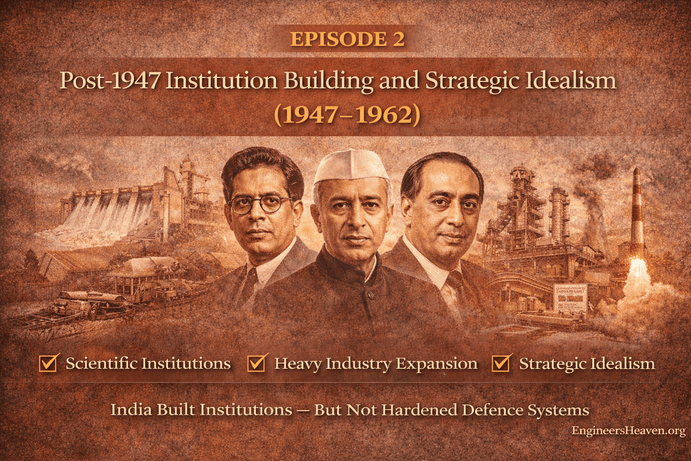
EPISODE 2 Post-1947 Institution Building and Strategic Idealism (1947–1962)
15 August 1947 — India became politically independent.
But sovereignty requires more than flags and constitutions.
It requires:
Scientific institutions
Industrial depth
Strategic clarity
Military preparedness
Between 1947 and 1962, India built powerful institutions — yet strategic idealism often outpaced military modernization.
1️⃣ Nehruvian Scientific StatecraftPrime Minister Jawaharlal Nehru viewed science as the foundation of modern India.
He famously called dams and laboratories the “temples of modern India.”
Key Institutional Milestones1948 – Atomic Energy Commission (AEC)
Chaired by Homi Jehangir Bhabha [1]
1954 – Department of Atomic Energy (DAE) [2]
1958 – Defence Research and Development Organisation (DRDO) [3]
These institutions created structured scientific governance within a young republic.
2️⃣ The Bhabha Nuclear VisionHomi Bhabha proposed a three-stage nuclear power program in the 1950s [4]:
Pressurized Heavy Water Reactors (PHWRs)
Fast Breeder Reactors
Thorium-based reactors
India possessed limited uranium but large thorium reserves.
Bhabha designed a long-term resource-based strategy decades ahead of global energy security debates.
3️⃣ Industrial Policy & Heavy Engineering ExpansionUnder the Second Five-Year Plan (1956–1961), architected by P. C. Mahalanobis, India emphasized:
Heavy machinery
Public sector steel plants
Infrastructure development
Major steel plants established with foreign collaboration:
Bhilai (USSR)
Rourkela (Germany)
Durgapur (UK)
(Planning Commission Records, 1956) [5]
Industrial depth expanded — but defence manufacturing integration remained limited.
4️⃣ DRDO Formation (1958)DRDO was created by merging:
Technical Development Establishment (TDEs)
Directorate of Technical Development and Production (DTDP)
[3]
Initial focus areas:
Armaments
Combat engineering
Military communications
However, funding and systems integration capacity were modest during this period.
5️⃣ Strategic Idealism & Panchsheel (1954)India signed the Panchsheel Agreement with China in 1954 [6].
Core principles:
Mutual respect
Non-aggression
Non-interference
India pursued Non-Alignment — balancing Cold War blocs without formal alliances.
Military modernization did not accelerate proportionately.
Strategic assessment underestimated Chinese infrastructure buildup in Tibet (Maxwell, 1970) [7].
6️⃣ The 1962 Sino-Indian War: Systemic Shock October–November 1962China launched coordinated offensives across:
Aksai Chin
NEFA (now Arunachal Pradesh)
Political Leadership:
Prime Minister Jawaharlal Nehru
Defence Minister:
V. K. Krishna Menon
(Official History of the 1962 War, Government of India) [8]
Engineering and structural weaknesses exposed:
Inadequate mountain warfare logistics
Insufficient high-altitude equipment
Poor intelligence integration
Weak air power utilization
1962 was not merely a battlefield defeat.
It was a systems failure.
Structural Assessment (1947–1962) Achievements✔ Creation of Atomic Energy Commission (1948)
✔ Establishment of DRDO (1958)
✔ Heavy industry expansion
✔ Institutional scientific governance
✔ Nuclear research roadmap
✖ Underinvestment in operational defence modernization
✖ Strategic overreliance on diplomacy
✖ Weak border infrastructure
✖ Limited integration between R&D and armed forces
1947–1962 was the era of institutional optimism.
India built laboratories, reactors, steel plants, and research councils.
But it did not yet build hardened defence systems aligned with geopolitical realities.
The 1962 war forced the transition from idealism to realism.
That transition defines Episode 3.
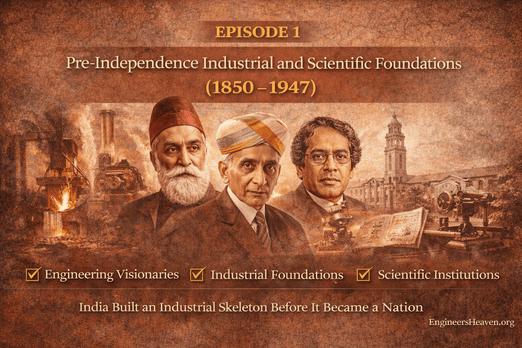
Episode 1: Pre-Independence Industrial and Scientific Foundations (c. 1850–1947)
(With embedded citation markers for direct publishing use)
Episode 1 — The Engineers Who Built Before the Nation Existed
Before 1947.
Before the Constitution.
Before sovereignty.
India already had engineers building the skeleton of a future nation.
This episode examines how industrialists, scientists, and institutional architects between 1850 and 1947 laid the structural, scientific, and industrial foundations that independent India would later inherit.
1️⃣ Industrial Modernity Under Colonial Constraint (1850s–1910s)
The British built railways and ports for extraction — but Indian engineers and industrialists learned from within that system.
Jamsetji Tata (1839–1904)
Founded Tata Iron and Steel Company (TISCO) in 1907 at Sakchi (later Jamshedpur) [1].
Commissioned India’s first integrated steel plant (production began 1912) [1].
Conceived the Indian Institute of Science (IISc) in 1898; established in 1909 in Bangalore [2].
Jamsetji Tata’s steel plant would later supply rails, defense materials, and heavy industrial inputs to independent India.
Without domestic steel, sovereignty remains theoretical.
Sir M. Visvesvaraya (1861–1962)
Designed the Krishna Raja Sagara (KRS) Dam (completed 1931) [3].
Introduced automatic sluice gates at Khadakwasla (1903) [3].
As Diwan of Mysore (1912–1918), promoted industrialization and technical education [3].
He institutionalized engineering discipline as a nation-building instrument — decades before political independence.
2️⃣ Scientific Institutionalization (1890s–1930s)
India’s scientific ecosystem did not begin in 1947. It matured under colonial constraints.
Jagadish Chandra Bose (1858–1937)
Demonstrated millimeter-wave radio transmission in 1895 [4].
Founded the Bose Institute in 1917 [4].
C. V. Raman (1888–1970)
Discovered the Raman Effect on 28 February 1928 [5].
Awarded Nobel Prize in Physics in 1930 [5].
These scientists established proof: Indians could generate frontier science, not merely import it.
3️⃣ Strategic Research Architecture Before Freedom (1930s–1947)
As global war intensified, the need for organized research became evident.
Council of Scientific and Industrial Research (CSIR)
Established 26 September 1942 under British India [6].
Spearheaded by Sir Shanti Swarup Bhatnagar (1894–1955) [6].
Bhatnagar structured CSIR into domain-specific laboratories — petroleum, chemicals, metallurgy, physics — forming the backbone of post-independence R&D.
4️⃣ Atomic Vision Before Atomic Sovereignty Homi Jehangir Bhabha (1909–1966)
Proposed nuclear research program to the Tata Trust in 1944 [7].
Founded the Tata Institute of Fundamental Research (TIFR) in 1945 [7].
TIFR later became the cradle of India’s nuclear and high-energy physics programs.
5️⃣ Engineering Nationalism Before Political Nationalism
By 1947, India already possessed:
An integrated steel plant (TISCO)
A premier science institute (IISc)
A structured research council (CSIR)
Foundational nuclear research infrastructure (TIFR)
Industrial engineering leadership (Visvesvaraya model)
Independence did not start from zero.
It inherited infrastructure built by engineers working under political limitation but with civilizational ambition.
Closing Reflection
Political independence occurred on 15 August 1947.
But engineering sovereignty had begun decades earlier.
The republic did not create engineers.
Engineers made the republic possible.
Pokhran-II (May 1998) declared India a nuclear weapons state (Government of India Statements, 1998).
But declaration is not deterrence.
Deterrence requires:
Delivery systems
Command-and-control architecture
Political doctrine
Industrial depth
Operational validation
Between 1998 and today, India built that architecture.
1. 1999 – Kargil War: Operational Stress Test May–July 1999
The Kargil conflict exposed:
Intelligence gaps
Surveillance weaknesses
High-altitude logistics challenges
(Raghavan, 2016)
Political Leadership:
Prime Minister Atal Bihari Vajpayee
Military Leadership:
Army Chief Gen. V. P. Malik
Air Chief Marshal A. Y. Tipnis
Engineering consequences:
Acceleration of UAV acquisition
Precision artillery upgrades
Surveillance modernization
Kargil became the post-nuclear operational validation phase.
2. 1999–2003: Nuclear Doctrine & Command Structure 1999 – Draft Nuclear Doctrine 2003 – Official Nuclear Doctrine
India formalized:
Credible Minimum Deterrence
No First Use (NFU)
Civilian political control over nuclear arsenal
(Government of India, 1999 Draft Doctrine; 2003 Cabinet Committee on Security Statement)
2003 – Strategic Forces Command (SFC) Established
This institutionalized nuclear command-and-control architecture.
Deterrence became structured, not symbolic.
3. Missile Maturation (2000s)
Under DRDO leadership and continued missile programs:
Agni-II operationalized (early 2000s)
Agni-III and later variants extended range capability
Prithvi variants refined
(DRDO Official Reports)
Key technical domains matured:
Re-entry vehicle materials
Solid propulsion optimization
Ring laser gyro navigation
Advanced guidance systems
Missile capability shifted from demonstration to deployment.
4. Civil Nuclear Diplomacy Breakthrough 2005–2008: India–U.S. Civil Nuclear Agreement
Political Leadership:
Prime Minister Manmohan Singh
U.S. President George W. Bush
2008 NSG Waiver allowed India civilian nuclear trade access (Tellis, 2011).
This was strategic normalization without signing NPT.
India moved from sanctioned isolation to conditional integration.
5. Indigenous Strategic Platforms INS Arihant (Launched 2009; Commissioned 2016)
India’s first indigenous nuclear-powered ballistic missile submarine.
Represents:
Sea-based deterrence
Completion of nuclear triad
(Indian Navy Official Statements)
Sea leg of deterrence is crucial for second-strike credibility.
6. Aerospace & Space Militarization 2007 – Agni-III Test 2012 – Agni-V Long-Range Test
(DRDO Archives)
2019 – Mission Shakti (Anti-Satellite Test)
Under Prime Minister Narendra Modi
India demonstrated anti-satellite capability (Government of India Statement, 2019).
This marked entry into space security domain.
7. Structural Reform: Chief of Defence Staff 2019 – Creation of Chief of Defence Staff (CDS)
First CDS:
General Bipin Rawat
This reform aimed to:
Improve tri-service integration
Strengthen joint operational planning
Enhance procurement efficiency
(Government of India Notification, 2019)
Institutional integration deepened.
8. Atmanirbhar Bharat & Defence Industrial Reform Post-2014: Defence Manufacturing Push
Key reforms:
Strategic Partnership Model
Increased FDI in defence sector
Defence corridors (Tamil Nadu, Uttar Pradesh)
Import negative lists
Domestic procurement prioritization
(Ministry of Defence Annual Reports)
Private sector participation expanded:
L&T
Tata Advanced Systems
Bharat Forge
Mahindra Defence
Defence production ecosystem diversified beyond DPSUs.
9. Indigenous Platforms of the 2010s–2020s
LCA Tejas operational induction (HAL Reports)
Dhanush artillery system
Pinaka multi-barrel rocket launcher
BrahMos supersonic cruise missile (India–Russia JV)
Advanced radar and electronic warfare systems
Engineering now spans:
Electronics
Materials science
Propulsion
Cyber capabilities
Space domain awareness
Structural Assessment (1998–Present)
Achievements:
✔ Nuclear doctrine institutionalized (1999/2003 Doctrine)
✔ Strategic Forces Command operationalized
✔ Nuclear triad established (INS Arihant)
✔ Long-range missile capability matured
✔ Space deterrence demonstrated (2019 ASAT)
✔ Defence industrial reform initiated
✔ Private sector participation increased
Limitations:
✖ Jet engine dependency persists
✖ Semiconductor and microelectronics vulnerability
✖ High-end propulsion technology gap
✖ Import reliance not fully eliminated
Core Insight
1998 declared deterrence.
1999 structured doctrine.
2003 institutionalized command.
2008 normalized diplomacy.
2016 completed nuclear triad.
2019 entered space deterrence.
Post-2014 industrial reforms attempt structural autonomy.
India is no longer building symbolic capability.
It is engineering layered deterrence across land, air, sea, and space.
.png)
1. Defence Reorganization After 1962 Defence Minister: Yashwantrao Balwantrao Chavan
Chavan:
Increased defence budget
Strengthened procurement systems
Improved civil-military coordination
This was structural reform.
2. 1965 War Leadership Prime Minister: Lal Bahadur Shastri
Shastri provided political clarity during conflict.
Army Chief: General J. N. Chaudhuri Air Chief: Air Chief Marshal Arjan Singh Naval Chief: Admiral B. S. Soman
The 1965 war revealed operational recovery from 1962, but import dependency remained (Roy, 2016).
3. Indigenous Aerospace Push HF-24 Marut Program
Led by:
Kurt Tank (German aeronautical engineer)
Indian aerospace engineers at HAL
This marked first indigenous fighter program — limited by engine technology gaps.
Institutionally critical despite operational limitations.
4. Space and Strategic Technology Vision Dr. Vikram Sarabhai
Founder of ISRO (1969).
Sarabhai’s contribution:
Rocket propulsion base
Launch vehicle research
Telemetry and systems engineering
Though civilian, long-term dual-use impact was undeniable.
5. 1971 War Leadership Prime Minister: Indira Gandhi
Political authority and diplomatic preparation were decisive.
Army Chief: Field Marshal Sam Manekshaw Eastern Command: Lt. General J. S. Aurora Air Chief: P. C. Lal Naval Chief: Admiral S. M. Nanda
1971 represented:
Mature tri-service coordination
Political-military synchronization
Improved logistics and mobility
This war validated post-1962 reforms (Raghavan, 2013).
6. Nuclear Authorization & Pokhran-I Political Approval (1972): Indira Gandhi Scientific Leadership:
Dr. Homi Sethna (AEC Chairman)
Dr. Raja Ramanna (Device Development Lead)
18 May 1974 – Pokhran-I
India demonstrated nuclear device capability.
This was culmination of:
Bhabha’s architecture
Reactor infrastructure
Strategic reassessment after 1964 Chinese test
(Perkovich, 1999; Abraham, 1998)
Structural Continuity of Leadership
1947–1962: Visionaries
Nehru – Bhabha – Mahalanobis
1962–1974: Reformers
Chavan – Shastri – Manekshaw – Indira Gandhi – Ramanna
The transition is clear:
From idealistic institution building
To war-tested strategic engineering.
.png) On 15 August 1947, India became politically sovereign.
Technological sovereignty, however, had to be engineered from the ground up.
On 15 August 1947, India became politically sovereign.
Technological sovereignty, however, had to be engineered from the ground up.
The first 15 years after independence were defined by:
Visionary scientific institution building
State-led industrial planning
Strategic optimism
And eventually, a severe military wake-up call
1. 1947–1950: The Immediate Post-Independence Condition
At independence, India inherited:
16 Ordnance Factories (Ministry of Defence Records)
A British-structured armed force system (Roy, 2013)
Limited indigenous weapons design capability
The armed forces were operationally experienced due to World War II participation, but heavily dependent on:
Imported aircraft
Imported artillery
Imported communications systems
Strategic design autonomy was nearly absent (Roy, 2016).
2. 1948: Atomic Energy Commission — Strategic Foresight 10 August 1948 – Establishment of the Atomic Energy Commission (AEC)
Formally constituted under the leadership of Dr. Homi J. Bhabha with Prime Minister Jawaharlal Nehru’s support (Government of India Resolution, 1948; Abraham, 1998).
This decision was extraordinary.
India was economically fragile, yet it prioritized atomic research — indicating long-term strategic thinking.
1954 – Creation of the Department of Atomic Energy (DAE)
DAE centralized nuclear research under the Prime Minister’s direct oversight (DAE Archives, 1954).
This created institutional architecture for:
Reactor physics
Nuclear fuel cycle research
Strategic materials capability
Even though weaponization was not declared policy, technical groundwork was laid (Perkovich, 1999).
3. 1950–1956: Industrial Planning and Heavy Engineering Push 1950 – Planning Commission Established
India adopted a state-directed industrialization model (First Five-Year Plan, 1951–56).
1956 – Second Five-Year Plan
Strongly influenced by P. C. Mahalanobis’ heavy-industry growth model (Mahalanobis, 1955; Second Five-Year Plan, 1956).
Focus areas included:
Steel production
Machine tools
Heavy engineering
Public sector manufacturing
Major developments:
Bhilai Steel Plant (with Soviet collaboration)
Rourkela Steel Plant (with German collaboration)
Durgapur Steel Plant (with British collaboration)
These steel plants were critical to long-term defence manufacturing capability (Frankel, 2005).
However, in the 1950s, much of the technology was still licensed or foreign-assisted.
4. Defence Public Sector Expansion Hindustan Aircraft Limited (later HAL)
Originally established in 1940, nationalized post-independence and expanded during the 1950s (HAL Archives).
HAL began licensed production of aircraft such as the HF-24 Marut later in the 1960s, but indigenous aerospace design capability was still developing.
1954 – Establishment of Bharat Electronics Limited (BEL)
Created to reduce dependence on imported military electronics (BEL Institutional History).
1958 – Heavy Engineering Corporation (HEC), Ranchi
Established to produce heavy industrial machinery essential for defence manufacturing (HEC Founding Records).
These institutions formed the industrial skeleton of future defence production.
5. 1958: Formation of DRDO 1958 – Creation of the Defence Research & Development Organisation (DRDO)
Formed by merging:
Technical Development Establishments (TDEs)
Directorate of Technical Development & Production
Defence Science Organisation
(DRDO Official History, 1958)
This marked the formal birth of India’s structured military R&D ecosystem.
However:
Funding was limited
Skilled manpower was scarce
Industrial supply chains were underdeveloped
DRDO was institutionally born — but operationally immature.
6. Nuclear Infrastructure Development (1956–1960) 1956 – Apsara Research Reactor Commissioned
India’s first nuclear reactor, built with UK assistance (BARC Archives).
1960 – CIRUS Reactor Became Operational
Constructed with Canadian assistance and U.S. heavy water supply (Perkovich, 1999).
These facilities established:
Reactor engineering expertise
Plutonium production potential
Nuclear materials research capability
Although India publicly emphasized peaceful nuclear use, technical capabilities accumulated (Abraham, 1998).
7. Strategic Assumptions and Defence Spending
India’s foreign policy during this period emphasized:
Non-alignment
Panchsheel Agreement (1954) with China
Diplomatic conflict resolution
(Raghavan, 2010)
Defence expenditure remained relatively constrained compared to perceived threats (Roy, 2016).
Strategic assumptions included:
Large-scale war unlikely
Border disputes manageable through negotiation
Institution building was prioritized over military modernization.
8. 1962: Sino-Indian War — Strategic Shock October–November 1962
China launched coordinated offensives across:
Aksai Chin
North-East Frontier Agency (NEFA)
India encountered:
Severe logistical breakdown in mountainous terrain
Inadequate winter equipment
Limited air power utilization
Weak artillery positioning
(Raghavan, 2010; Roy, 2016)
The war exposed:
Overreliance on diplomatic optimism
Underinvestment in operational readiness
Weak civil-military coordination
Incomplete military-industrial integration
Even though industrial institutions had been created, their defence alignment was insufficient.
9. Post-1962 Structural Realization
After 1962:
Defence spending increased significantly (Roy, 2016)
Emergency military modernization initiated
Border infrastructure projects accelerated
Civil-military planning coordination improved
The lesson was clear:
Scientific ambition without strategic preparedness is structurally fragile.
Structural Assessment of 1947–1962
Achievements:
✔ Atomic energy institutionalization (Abraham, 1998)
✔ Public sector heavy engineering base (Frankel, 2005)
✔ Formal defence R&D creation (DRDO Archives)
✔ Early nuclear reactor capability (Perkovich, 1999)
Failures or gaps:
✖ Underestimation of geopolitical risk (Raghavan, 2010)
✖ Slow military modernization
✖ Weak systems integration
✖ Limited indigenous weapons design
1962 was not just a battlefield setback.
It was an engineering systems failure.
Core Insight
1947–1962 was the age of scientific optimism and industrial structuring.
But defence engineering requires:
Technology
Industrial scale
Military doctrine
Political realism
Systems integration
The absence of synchronization among these elements led to 1962.
Next Episode:
1962–1974: Militarization, 1965 & 1971 Wars, and the Road to Pokhran-I
.png)
India’s defence engineering journey did not begin in 1947
It evolved through layered developments during colonial rule — industrial, scientific, and institutional — but without sovereign control.
Understanding this distinction is critical.
1. Colonial Industrial Infrastructure (18th–Early 20th Century)
1775 – Establishment of the Gun Carriage Agency, Cossipore
One of the earliest organized military production units in India (Ordnance Factory Board Archives).
1801 – Gun Carriage Factory, Kanpur
Expanded artillery production capability (Roy, 2006).
1904 – Rifle Factory, Ishapore
Enabled local production of small arms under British direction (Government of India, Ministry of Defence).
These facilities created:
Precision machining culture
Metallurgical competence
Ammunition and artillery manufacturing skill
However, design authority, system architecture, and strategic command remained British-controlled (Tan Tai Yong, 2005).
India manufactured.
Britain decided.
2. Railway Engineering & Logistics Backbone
1853 – First Passenger Railway Line (Bombay to Thane)
Over the next decades, India developed one of the largest railway networks in the world (Kerr, 2007).
By 1947, India had over 53,000 km of railway track (Indian Railways Historical Records).
Railways became:
A logistics backbone
A mechanical engineering training ground
A large-scale maintenance ecosystem
This indirectly built heavy fabrication and workshop capability — but not sovereign defence planning (Kerr, 2007).
3. Telegraph & Early Communication Networks
1851 – First Telegraph Line (Calcutta to Diamond Harbour)
By the late 19th century, India had an extensive telegraph system (Headrick, 1981).
This introduced:
Electrical engineering familiarity
Signal systems management
Network-scale operations
Yet command authority remained external (Headrick, 1981).
4. Scientific Assertion Begins (Late 19th – Early 20th Century)
1895–1900 – Sir Jagadish Chandra Bose
Demonstrated microwave and radio wave experiments prior to widespread wireless commercialization (Bose, 1902).
1930 – Sir C. V. Raman awarded Nobel Prize in Physics
Established global scientific credibility for Indian research institutions (Raman Nobel Lecture, 1930).
Scientific confidence is a prerequisite for engineering sovereignty (Subbarayappa, 2001).
5. Institutional Milestones
1909 – Establishment of the Indian Institute of Science (IISc), Bangalore
Founded through Jamsetji Tata’s vision and Mysore state support (IISc Archives, 1909).
By the 1930s–40s, IISc contributed to:
Aeronautical engineering training
Metallurgical research
Industrial chemistry
Electrical engineering
During World War II (1939–1945), IISc supported technical training and aircraft maintenance assistance (IISc Historical Records).
This marked a shift:
From industrial labor to scientific education.
6. Industrial Capital & Steel Foundations
1907 – Tata Iron and Steel Company (TISCO) established in Jamshedpur
Steel production became foundational to heavy industry and wartime logistics (Tripathi & Jumani, 2007).
During both World Wars, Tata Steel supplied material for imperial war efforts (Wolpert, various editions; Tata Steel Archives).
By the 1940s, India possessed:
Basic steel production
Heavy industrial fabrication capability
Skilled industrial workforce
But not independent defence metallurgy research.
7. Early Strategic Scientific Vision
1944 – Bhabha’s Letter to Sir Dorabji Tata Trust
Dr. Homi Jehangir Bhabha proposed the establishment of advanced scientific research infrastructure in India (Tata Central Archives).
1945 – Establishment of Tata Institute of Fundamental Research (TIFR)
TIFR marked the beginning of organized high-level scientific research in India (TIFR Institutional History; Abraham, 1998).
Before independence, there was already awareness of atomic science importance — but not operational nuclear capability.
8. World War II: Scale Without Sovereignty (1939–1945)
World War II dramatically expanded India’s industrial output (Roy, 2016; Bayly & Harper, 2004):
Ammunition manufacturing scaled massively
Vehicle assembly and repair expanded
Military logistics intensified
India became one of the largest Allied supply bases in Asia.
But:
Aircraft design decisions were British
Naval command structures were British
Strategic doctrine was external (Roy, 2016)
India proved production capability.
It did not control defence design direction.
9. The Situation at Independence (1947)
On 15 August 1947, India inherited:
✔ 16 major ordnance factories (Ministry of Defence Records)
✔ A vast railway engineering network (Indian Railways Archives)
✔ Emerging scientific institutions (IISc, TIFR)
✔ Industrial steel production (Tripathi & Jumani, 2007)
✔ Skilled mechanical workforce
But it lacked:
✖ Indigenous defence R&D ecosystem
✖ Strategic weapons design programs
✖ Nuclear infrastructure
✖ Advanced electronics capability
✖ Systems integration doctrine
India inherited industrial fragments.
It did not inherit strategic coherence.
Core Historical Insight
Between 1775 and 1947, India developed:
Manufacturing capability
Scientific legitimacy
Industrial scale
Technical education seeds
But sovereignty over defence engineering decisions remained outside India.
Pre-1947 India was an industrial contributor.
Post-1947 India would have to become a defence architect.
A Chronological Engineering History
India’s defence strength today is often measured in visible terms:
troop strength, aircraft fleets, missile ranges, naval tonnage.
But these are outcomes.
Behind them lies a far more complex story — one of institution building, engineering discipline, scientific persistence, political constraint, and technological self-reliance.
This series is not about weapons.
It is about how a nation built capability.
What This Series Is — and Is Not
This is not:
a military showcase,
a political endorsement,
or a celebration of hardware.
It is a structured, chronological study of how:
engineering institutions were created,
scientific ecosystems matured,
technology denial shaped innovation,
political decisions influenced engineering priorities,
and long-term sovereignty emerged from technical competence.
India did not become a strong defence nation in a single decade, nor through a single leader or breakthrough.
It evolved through layers of learning — including failure.
Why Chronology Matters
Defence capability is cumulative.
Each phase of India’s history added something distinct:
Colonial infrastructure without sovereignty
Post-independence institution building
Technological shocks and wake-up calls
Sanctions and isolation
Indigenous engineering under constraint
Economic liberalization and dual-use technology growth
Strategic assertion and systems integration
Networked, multi-domain defence ecosystems
To understand present strength, one must understand how each layer formed.
This series will follow that progression carefully.
Integration of Four Dimensions
Each episode will examine four interconnected dimensions:
1. History
What events shaped strategic thinking?
2. Politics
What constraints, alliances, sanctions, or policy decisions influenced engineering direction?
3. Science & Technology
What knowledge systems were available? What research matured? What was denied?
4. Engineering Execution
How were institutions built?
How were systems designed?
How was reliability achieved?
What industrial base supported it?
National defence is not the product of any single dimension.
It is the result of all four interacting over decades.
A Note on Transparency and Limits
Modern defence systems involve classified components.
This series will not attempt to:
disclose operational specifications,
analyze sensitive performance data,
or speculate on confidential capabilities.
The focus will remain on:
institutional evolution,
publicly documented milestones,
scientific progress,
engineering culture,
and strategic intent.
Accuracy and intellectual responsibility will guide every episode.
Why This Matters Today
India’s defence capability today includes:
air systems,
ground platforms,
naval fleets,
nuclear deterrence,
space-enabled assets,
electronic warfare,
and increasingly, networked and cyber-integrated systems.
But capability without context is misunderstood.
Understanding the journey provides:
respect for institutional continuity,
appreciation for engineering discipline,
clarity on the role of sanctions in shaping innovation,
and perspective on what technological sovereignty truly requires.
This series aims to provide that perspective.
The Central Thesis
India became a strong defence nation not through aggression,
but through:
persistence under denial,
engineering under constraint,
institution building before visibility,
and long-term scientific investment.
Its strength is cumulative, not theatrical.
What Comes Next
The series will proceed chronologically:
Each phase will be examined through the lens of engineering history.
Closing Note
An army’s courage is immediate.
Engineering capability is generational.
India’s defence story is, at its core, an engineering story.
And it deserves to be told carefully.
— EngineersHeaven.org
If you are a victim of or witness to AI-generated abuse (Deepfakes/NCII), use these official Indian government channels.
1. Immediate Legal Reporting (NCRP)
Portal: cybercrime.gov.in
The "Golden Rule": Select the "Report Crime Against Women/Children" category for faster routing.
Status: This is the primary portal managed by the I4C (Indian Cybercrime Coordination Centre).
2. The "2-Hour" Takedown Request
Under the IT Rules 2026 (Effective Feb 20), social media platforms (Meta, X, YouTube, etc.) have a strict timeline to remove non-consensual deepfakes:
Nudity/Sexual Acts: Must be removed within 2 hours of your complaint.
Impersonation/Identity Theft: Must be removed within 36 hours.
Government/Court Orders: Platforms now have only 3 hours to comply.
Action: Report directly via the platform's "Grievance Officer" link and mention: "Requesting removal under Rule 3(2)(b) of IT Rules 2026."
The Indian government officially notified these changes on February 10, 2026, via Gazette Notification number G.S.R. 120(E). They come into force tomorrow, February 20, 2026.
Official Reference LinksMinistry of Electronics and Information Technology (MeitY): IT Amendment Rules 2026 (Official Notification & FAQ Page)
Note: This link contains the consolidated text and the "Frequently Asked Questions" released by the Ministry specifically for the 2026 amendments.
The Gazette of India (Digital Archive): Search for G.S.R. 120(E)
This is the ultimate legal proof. You can search by the notification number G.S.R. 120(E) dated 10th February 2026.
Rule 2(1)(wa): Defines "Synthetically Generated Information" (SGI)—the first time AI content has a formal legal definition in India.
Rule 3(2)(b): This is the "2-Hour Rule." It mandates the removal of non-consensual deepfakes (nudity/sexual acts/impersonation) within 120 minutes of a complaint.
Rule 3(1)(d): This is the "3-Hour Rule." It mandates platforms remove unlawful AI content within 180 minutes of receiving a court or government order.
Rule 3(3): Mandates "Safety by Design." It requires platforms that offer AI tools to deploy technical measures to prevent the creation of harmful content (like deepfakes of real people).
3. Reporting "Grok" & AI Fraud (Chakshu)
If you receive AI-generated voice scams or deepfake links via WhatsApp/SMS:
Portal: sancharsaathi.gov.in/sfc (Chakshu Facility).
Action: This triggers immediate re-verification of the sender's mobile identity.
4. Technical & National Threats (CERT-In)
For reporting malicious AI websites, large-scale data breaches, or "hazardous" AI tools:
Email: incident@cert-in.org.in
Portal: cert-in.org.in
1. How to Report on GitHub
GitHub’s Terms of Service (updated for the 2026 Data Act) strictly prohibit "Sexually Explicit Content" and "Harassment."
Action: Go to the Repository. Click the "Report Content" flag (usually under the "About" section or triple dots).
Select: "Illegal Content" or "Harassment/Abuse."
The Comment: "This repository contains fine-tuned models/LoRAs specifically designed for non-consensual sexual imagery (Deepfakes), violating the UK Data Act 2026 and EU AI Act safety protocols."
2. How to Report on Hugging Face
Hugging Face is currently under heavy pressure from the EU to clean up their "Uncensored" models.
Action: Click the "Report" button on the Model card.
The Comment: "This model/dataset is trained on non-consensual imagery for the purpose of 'nudification.' It lacks the mandatory safety guardrails required for Foundation Models under current EU/US regulations."
3. Reporting to Law Enforcement
As of February 2026, if you find a site or a tool that is actively generating images of minors, do not just report the site.
if you are Indian citizen then
follow the link below for details
.1. Master Essential Software & Technical Skills
Software proficiency is non-negotiable in the modern Indian job market.- Drafting & Design: Learn AutoCAD (2D/3D) for creating blueprints and Revit for Building Information Modeling (BIM).
- Analysis: Master STAAD.Pro or ETABS for structural analysis and building design.
- Data Management: Become an expert in MS Excel for calculating quantities (BOQ), preparing schedules, and reporting.
- Core Fundamentals: Ensure you can read and interpret architectural drawings, prepare a Bar Bending Schedule (BBS), and understand on-site tests for soil and concrete.
2. Gain Practical Exposure
- Internships: Complete at least one 2–3 month internship at a construction site or design firm. This provides hands-on experience with site supervision, material quality checks, and safety rules.
- Site Visits: Regularly visit local construction sites to observe how surveyors and supervisors work.
- Academic Projects: Choose a final-year project that aligns with your desired specialization (e.g., sustainable materials or bridge design) to showcase your specific interests to recruiters.
3. Build a Professional Presence
- Resume: Use an ATS-friendly format highlighting your technical skills, internships, and measurable achievements (e.g., "Reduced material waste by 10% during internship").
- LinkedIn: Create a professional profile with project photos and certifications. Connect with alumni and HR professionals at top firms like L&T, Tata Projects, or Afcons.
- Certifications: Obtain specialized certificates in areas like Quantity Surveying, BIM, or Project Management (PMP) to stand out.
4. Prepare for Competitive Exams (Government Path)
If you prefer a government career, focus on clearing national or state-level exams:- SSC JE: For Junior Engineer roles in central departments like CPWD or MES.
- GATE: High scores can lead to Scientist/Engineer positions at ISRO or management trainee roles in PSUs like ONGC, GAIL, and NHAI.
5. Interview Mindset
Be prepared to explain the "why" behind technical concepts. Interviewers often ask about your previous team experiences and your approach to solving site problems, such as preventing cave-ins during excavation. Use the STAR method (Situation, Task, Action, Result) to answer behavioral questions.