User Ideas / Prospects

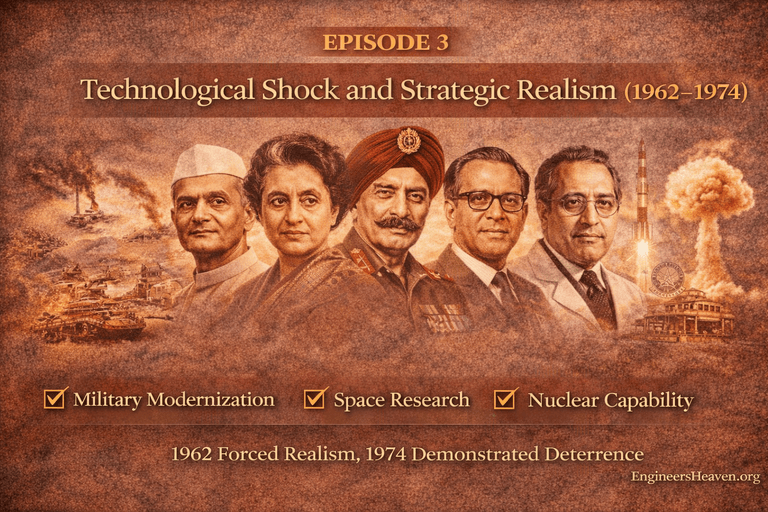
1962 did not just expose a military weakness.
It exposed a systems failure.
From 1962 to 1974, India transitioned from strategic idealism to strategic realism — integrating war experience, industrial acceleration, space research, and nuclear capability into a coherent national security framework.
This is the decade where engineering became geopolitical.
1️⃣ 1962: The Shock That Restructured Defence October–November 1962 – Sino-Indian War
(Official History of the 1962 War, Government of India) [1]
Political Leadership:
Jawaharlal Nehru
Defence Minister (until October 1962):
V. K. Krishna Menon
Failures exposed:
Border infrastructure deficit
High-altitude logistics weakness
Intelligence integration gaps
Air power underutilization
The lesson: institutions without operational readiness collapse under stress.
2️⃣ Structural Reforms After 1962 Yashwantrao B. Chavan Appointed Defence Minister (November 1962)
Yashwantrao Chavan initiated rapid military modernization [2]:
Expansion of mountain divisions
Accelerated ordnance production
Procurement reform
Strengthening of training doctrines
Defence spending increased significantly between 1962–1965 (Government Budget Records) [3].
Engineering began aligning with battlefield needs.
3️⃣ 1965 War: Tactical Recovery August–September 1965 – Indo-Pak War
(Official History, Ministry of Defence) [4]
Prime Minister:
Lal Bahadur Shastri
Military Leadership:
Gen. J. N. Chaudhuri
This conflict demonstrated improved mobilization and operational coherence compared to 1962.
However, dependence on imported equipment remained high.
Lesson: Tactical resilience improved; strategic autonomy still incomplete.
4️⃣ Indigenous Aerospace Effort – HF-24 Marut First Flight: 17 June 1961
Operational induction: mid-1960s [5]
Designed by German engineer Kurt Tank under HAL.
Though underpowered (engine limitations), the HF-24 Marut marked India’s first indigenous jet fighter project.
It revealed a structural gap: propulsion technology dependency.
5️⃣ Space as Strategic Engineering 1969 – Formation of ISRO
Founded by Vikram Sarabhai [6]
Sarabhai’s vision:
Space for development
Satellite communication
Remote sensing
Indigenous launch capability
Space engineering laid foundations for:
Ballistic trajectory understanding
Solid propulsion systems
Systems integration culture
Though civilian in doctrine, the technological spillover would later support strategic capability.
6️⃣ 1971 War: Integrated Military Confidence December 1971 – Indo-Pak War
(Official War History, Government of India) [7]
Prime Minister:
Indira Gandhi
Army Chief:
Sam Manekshaw
Outcome:
Creation of Bangladesh
Coordinated tri-service execution
Clear strategic objective
Engineering implications:
Improved logistics
Better communications systems
Coordinated command planning
1971 restored strategic confidence.
7️⃣ Nuclear Assertion – Pokhran-I 18 May 1974 – “Smiling Buddha” Test
(Pokhran, Rajasthan) [8]
Prime Minister:
Indira Gandhi
Scientific Leadership:
Raja Ramanna
Homi Sethna
India conducted a “peaceful nuclear explosion.”
This marked:
Entry into nuclear-capable states
Assertion of technological sovereignty
Trigger for future sanctions
The nuclear test was not sudden.
It was the culmination of two decades of atomic research architecture initiated under Bhabha.
Structural Assessment (1962–1974) Achievements
✔ Defence modernization post-1962
✔ Improved battlefield integration (1965 & 1971)
✔ Indigenous aerospace experimentation (HF-24)
✔ ISRO formation (1969)
✔ Nuclear demonstration (1974)
Limitations
✖ Propulsion dependency
✖ Electronics and avionics import reliance
✖ Early missile capability absent
✖ Industrial base not fully defence-integrated
Core Insight
1962 created urgency.
1965 restored balance.
1971 demonstrated strategic coordination.
1974 asserted nuclear capability.
Between 1962 and 1974, India transformed from an idealistic republic into a state aware of power, deterrence, and technological sovereignty.
This realism would trigger sanctions.
Sanctions would trigger indigenous engineering acceleration.
That is Episode 4.
???? Reference List
[1] Government of India – Official History of the 1962 Sino-Indian War
[2] Ministry of Defence Archives – Y. B. Chavan Reforms (1962–1965)
[3] Government Budget Documents (1962–1965 Defence Expenditure Increase)
[4] Ministry of Defence – Official History of the 1965 War
[5] HAL Archives – HF-24 Marut Program Records
[6] ISRO Official History – Establishment (1969)
[7] Government of India – Official History of the 1971 War
[8] Government of India – Pokhran-I Test Documentation (18 May 1974)
