User Ideas / Prospects

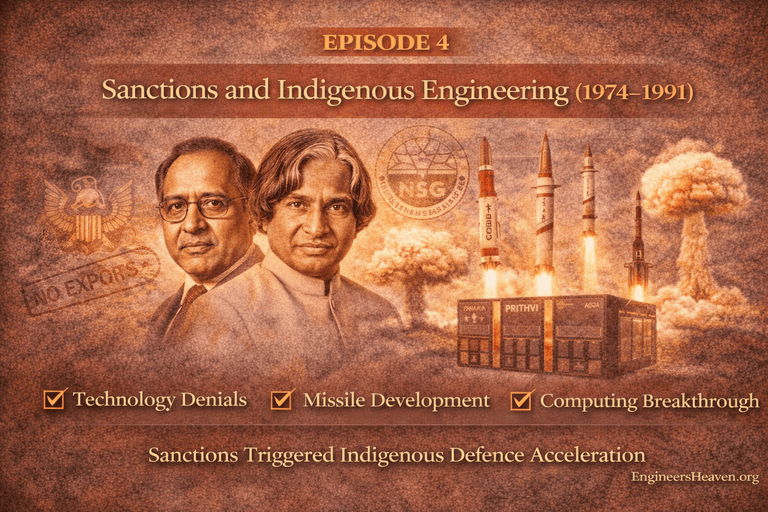 EPISODE 4 Sanctions and Indigenous Engineering (1974–1991)
18 May 1974 — Pokhran-I.
India demonstrated nuclear capability.
The global response was swift.
And punitive.
This episode examines how external sanctions unintentionally accelerated indigenous engineering capacity and forced India into self-reliant systems development.
1️⃣ Immediate Global Reaction (1974–1975)After the Pokhran-I test:
Canada suspended nuclear cooperation [1]
The United States tightened technology exports [2]
The Nuclear Suppliers Group was formed in 1975 specifically to regulate nuclear technology transfers after India’s test [3]
India entered a technology denial regime.
Critical imports restricted included:
Nuclear materials
Precision instrumentation
Advanced electronics
High-performance computing
The objective: isolate India technologically.
The result: internal capability development.
2️⃣ Nuclear Continuity Under PressureScientific leadership during post-1974 consolidation:
Raja Ramanna
Homi Sethna
They ensured:
Continuity of nuclear fuel cycle research
Reactor engineering progress
Indigenous heavy water production scaling
India expanded:
Heavy Water Board operations
Reactor design capability
Uranium processing autonomy
Sanctions created engineering compulsion.
3️⃣ Integrated Guided Missile Development Programme (IGMDP) Launched: 1983Approved under Prime Minister Indira Gandhi [4]
Scientific Director:
A. P. J. Abdul Kalam
Missile Systems Initiated:
Prithvi (Surface-to-Surface)
Agni (Ballistic)
Akash (Surface-to-Air)
Trishul
Nag
The IGMDP was not incremental.
It was systemic.
It forced domestic development of:
Solid propulsion systems
Guidance electronics
Composite materials
Re-entry vehicle technology
Sanctions blocked imports.
Engineering filled the gap.
4️⃣ High-Performance Computing DenialDuring the 1980s, India requested supercomputing access for weather modelling and defence simulation.
The United States denied Cray supercomputer exports [5].
Response:
India established the Centre for Development of Advanced Computing (C-DAC) in 1988 [6].
Result:
Development of the PARAM supercomputer series.
Technology denial catalyzed indigenous computing architecture.
5️⃣ Agni Technology Demonstrator 22 May 1989 – First Agni Test [7]Under A. P. J. Abdul Kalam’s leadership.
This test validated:
Re-entry heat shield design
Solid-fuel booster staging
Missile guidance integration
The Agni program marked India's entry into long-range deterrence capability.
6️⃣ Structural Assessment (1974–1991) Achievements✔ Indigenous missile ecosystem initiated
✔ Nuclear fuel cycle autonomy strengthened
✔ Supercomputing capability developed
✔ Electronics and materials research expanded
✔ Systems integration culture matured
✖ Electronics industry still underdeveloped
✖ Dependence on foreign propulsion technologies remained in aviation
✖ Industrial liberalization yet to occur
✖ Private sector defence participation negligible
1974 triggered sanctions.
Sanctions triggered necessity.
Necessity triggered indigenous engineering acceleration.
By 1991, India had:
Missile prototypes
Nuclear infrastructure
Indigenous computing capability
Structured defence R&D ecosystem
But it lacked:
Economic velocity
Industrial scale
Private sector dynamism
That changes in Episode 5.
???? Reference List[1] Government of Canada – Nuclear Cooperation Suspension (1974)
[2] U.S. Export Control Amendments (Post-1974 Nuclear Test)
[3] Nuclear Suppliers Group – Formation Records (1975)
[4] DRDO Archives – IGMDP Launch (1983)
[5] U.S. Technology Export Denial Records – Cray Supercomputer Case (1980s)
[6] C-DAC Official History – Establishment (1988)
[7] DRDO Missile Program Archives – Agni TD Test (22 May 1989)
