User Ideas / Prospects

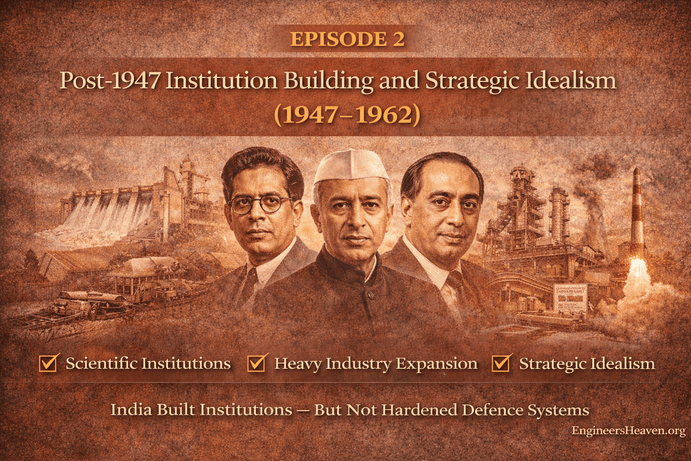
EPISODE 2 Post-1947 Institution Building and Strategic Idealism (1947–1962)
15 August 1947 — India became politically independent.
But sovereignty requires more than flags and constitutions.
It requires:
Scientific institutions
Industrial depth
Strategic clarity
Military preparedness
Between 1947 and 1962, India built powerful institutions — yet strategic idealism often outpaced military modernization.
1️⃣ Nehruvian Scientific StatecraftPrime Minister Jawaharlal Nehru viewed science as the foundation of modern India.
He famously called dams and laboratories the “temples of modern India.”
Key Institutional Milestones1948 – Atomic Energy Commission (AEC)
Chaired by Homi Jehangir Bhabha [1]
1954 – Department of Atomic Energy (DAE) [2]
1958 – Defence Research and Development Organisation (DRDO) [3]
These institutions created structured scientific governance within a young republic.
2️⃣ The Bhabha Nuclear VisionHomi Bhabha proposed a three-stage nuclear power program in the 1950s [4]:
Pressurized Heavy Water Reactors (PHWRs)
Fast Breeder Reactors
Thorium-based reactors
India possessed limited uranium but large thorium reserves.
Bhabha designed a long-term resource-based strategy decades ahead of global energy security debates.
3️⃣ Industrial Policy & Heavy Engineering ExpansionUnder the Second Five-Year Plan (1956–1961), architected by P. C. Mahalanobis, India emphasized:
Heavy machinery
Public sector steel plants
Infrastructure development
Major steel plants established with foreign collaboration:
Bhilai (USSR)
Rourkela (Germany)
Durgapur (UK)
(Planning Commission Records, 1956) [5]
Industrial depth expanded — but defence manufacturing integration remained limited.
4️⃣ DRDO Formation (1958)DRDO was created by merging:
Technical Development Establishment (TDEs)
Directorate of Technical Development and Production (DTDP)
[3]
Initial focus areas:
Armaments
Combat engineering
Military communications
However, funding and systems integration capacity were modest during this period.
5️⃣ Strategic Idealism & Panchsheel (1954)India signed the Panchsheel Agreement with China in 1954 [6].
Core principles:
Mutual respect
Non-aggression
Non-interference
India pursued Non-Alignment — balancing Cold War blocs without formal alliances.
Military modernization did not accelerate proportionately.
Strategic assessment underestimated Chinese infrastructure buildup in Tibet (Maxwell, 1970) [7].
6️⃣ The 1962 Sino-Indian War: Systemic Shock October–November 1962China launched coordinated offensives across:
Aksai Chin
NEFA (now Arunachal Pradesh)
Political Leadership:
Prime Minister Jawaharlal Nehru
Defence Minister:
V. K. Krishna Menon
(Official History of the 1962 War, Government of India) [8]
Engineering and structural weaknesses exposed:
Inadequate mountain warfare logistics
Insufficient high-altitude equipment
Poor intelligence integration
Weak air power utilization
1962 was not merely a battlefield defeat.
It was a systems failure.
Structural Assessment (1947–1962) Achievements✔ Creation of Atomic Energy Commission (1948)
✔ Establishment of DRDO (1958)
✔ Heavy industry expansion
✔ Institutional scientific governance
✔ Nuclear research roadmap
✖ Underinvestment in operational defence modernization
✖ Strategic overreliance on diplomacy
✖ Weak border infrastructure
✖ Limited integration between R&D and armed forces
1947–1962 was the era of institutional optimism.
India built laboratories, reactors, steel plants, and research councils.
But it did not yet build hardened defence systems aligned with geopolitical realities.
The 1962 war forced the transition from idealism to realism.
That transition defines Episode 3.
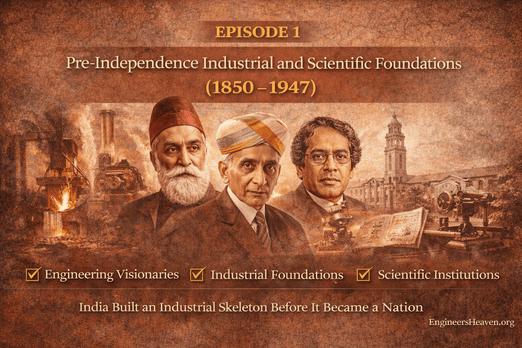
Episode 1: Pre-Independence Industrial and Scientific Foundations (c. 1850–1947)
(With embedded citation markers for direct publishing use)
Episode 1 — The Engineers Who Built Before the Nation Existed
Before 1947.
Before the Constitution.
Before sovereignty.
India already had engineers building the skeleton of a future nation.
This episode examines how industrialists, scientists, and institutional architects between 1850 and 1947 laid the structural, scientific, and industrial foundations that independent India would later inherit.
1️⃣ Industrial Modernity Under Colonial Constraint (1850s–1910s)
The British built railways and ports for extraction — but Indian engineers and industrialists learned from within that system.
Jamsetji Tata (1839–1904)
Founded Tata Iron and Steel Company (TISCO) in 1907 at Sakchi (later Jamshedpur) [1].
Commissioned India’s first integrated steel plant (production began 1912) [1].
Conceived the Indian Institute of Science (IISc) in 1898; established in 1909 in Bangalore [2].
Jamsetji Tata’s steel plant would later supply rails, defense materials, and heavy industrial inputs to independent India.
Without domestic steel, sovereignty remains theoretical.
Sir M. Visvesvaraya (1861–1962)
Designed the Krishna Raja Sagara (KRS) Dam (completed 1931) [3].
Introduced automatic sluice gates at Khadakwasla (1903) [3].
As Diwan of Mysore (1912–1918), promoted industrialization and technical education [3].
He institutionalized engineering discipline as a nation-building instrument — decades before political independence.
2️⃣ Scientific Institutionalization (1890s–1930s)
India’s scientific ecosystem did not begin in 1947. It matured under colonial constraints.
Jagadish Chandra Bose (1858–1937)
Demonstrated millimeter-wave radio transmission in 1895 [4].
Founded the Bose Institute in 1917 [4].
C. V. Raman (1888–1970)
Discovered the Raman Effect on 28 February 1928 [5].
Awarded Nobel Prize in Physics in 1930 [5].
These scientists established proof: Indians could generate frontier science, not merely import it.
3️⃣ Strategic Research Architecture Before Freedom (1930s–1947)
As global war intensified, the need for organized research became evident.
Council of Scientific and Industrial Research (CSIR)
Established 26 September 1942 under British India [6].
Spearheaded by Sir Shanti Swarup Bhatnagar (1894–1955) [6].
Bhatnagar structured CSIR into domain-specific laboratories — petroleum, chemicals, metallurgy, physics — forming the backbone of post-independence R&D.
4️⃣ Atomic Vision Before Atomic Sovereignty Homi Jehangir Bhabha (1909–1966)
Proposed nuclear research program to the Tata Trust in 1944 [7].
Founded the Tata Institute of Fundamental Research (TIFR) in 1945 [7].
TIFR later became the cradle of India’s nuclear and high-energy physics programs.
5️⃣ Engineering Nationalism Before Political Nationalism
By 1947, India already possessed:
An integrated steel plant (TISCO)
A premier science institute (IISc)
A structured research council (CSIR)
Foundational nuclear research infrastructure (TIFR)
Industrial engineering leadership (Visvesvaraya model)
Independence did not start from zero.
It inherited infrastructure built by engineers working under political limitation but with civilizational ambition.
Closing Reflection
Political independence occurred on 15 August 1947.
But engineering sovereignty had begun decades earlier.
The republic did not create engineers.
Engineers made the republic possible.
