User Ideas / Prospects

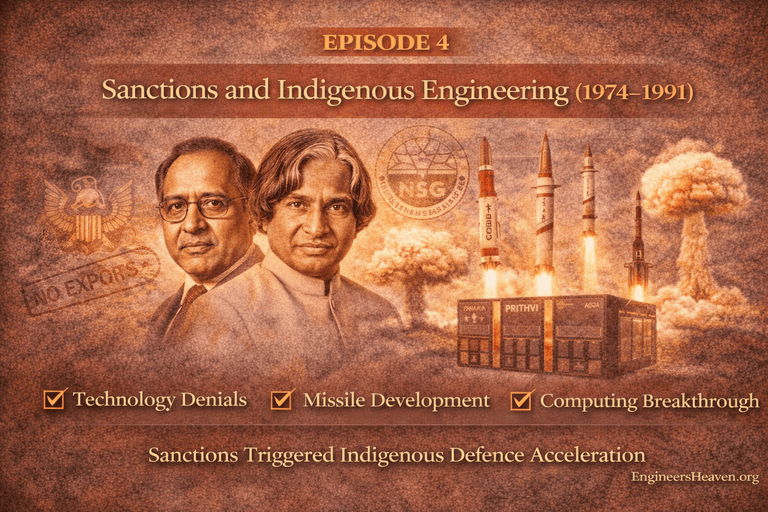 EPISODE 4 Sanctions and Indigenous Engineering (1974–1991)
18 May 1974 — Pokhran-I.
India demonstrated nuclear capability.
The global response was swift.
And punitive.
This episode examines how external sanctions unintentionally accelerated indigenous engineering capacity and forced India into self-reliant systems development.
1️⃣ Immediate Global Reaction (1974–1975)After the Pokhran-I test:
Canada suspended nuclear cooperation [1]
The United States tightened technology exports [2]
The Nuclear Suppliers Group was formed in 1975 specifically to regulate nuclear technology transfers after India’s test [3]
India entered a technology denial regime.
Critical imports restricted included:
Nuclear materials
Precision instrumentation
Advanced electronics
High-performance computing
The objective: isolate India technologically.
The result: internal capability development.
2️⃣ Nuclear Continuity Under PressureScientific leadership during post-1974 consolidation:
Raja Ramanna
Homi Sethna
They ensured:
Continuity of nuclear fuel cycle research
Reactor engineering progress
Indigenous heavy water production scaling
India expanded:
Heavy Water Board operations
Reactor design capability
Uranium processing autonomy
Sanctions created engineering compulsion.
3️⃣ Integrated Guided Missile Development Programme (IGMDP) Launched: 1983Approved under Prime Minister Indira Gandhi [4]
Scientific Director:
A. P. J. Abdul Kalam
Missile Systems Initiated:
Prithvi (Surface-to-Surface)
Agni (Ballistic)
Akash (Surface-to-Air)
Trishul
Nag
The IGMDP was not incremental.
It was systemic.
It forced domestic development of:
Solid propulsion systems
Guidance electronics
Composite materials
Re-entry vehicle technology
Sanctions blocked imports.
Engineering filled the gap.
4️⃣ High-Performance Computing DenialDuring the 1980s, India requested supercomputing access for weather modelling and defence simulation.
The United States denied Cray supercomputer exports [5].
Response:
India established the Centre for Development of Advanced Computing (C-DAC) in 1988 [6].
Result:
Development of the PARAM supercomputer series.
Technology denial catalyzed indigenous computing architecture.
5️⃣ Agni Technology Demonstrator 22 May 1989 – First Agni Test [7]Under A. P. J. Abdul Kalam’s leadership.
This test validated:
Re-entry heat shield design
Solid-fuel booster staging
Missile guidance integration
The Agni program marked India's entry into long-range deterrence capability.
6️⃣ Structural Assessment (1974–1991) Achievements✔ Indigenous missile ecosystem initiated
✔ Nuclear fuel cycle autonomy strengthened
✔ Supercomputing capability developed
✔ Electronics and materials research expanded
✔ Systems integration culture matured
✖ Electronics industry still underdeveloped
✖ Dependence on foreign propulsion technologies remained in aviation
✖ Industrial liberalization yet to occur
✖ Private sector defence participation negligible
1974 triggered sanctions.
Sanctions triggered necessity.
Necessity triggered indigenous engineering acceleration.
By 1991, India had:
Missile prototypes
Nuclear infrastructure
Indigenous computing capability
Structured defence R&D ecosystem
But it lacked:
Economic velocity
Industrial scale
Private sector dynamism
That changes in Episode 5.
???? Reference List[1] Government of Canada – Nuclear Cooperation Suspension (1974)
[2] U.S. Export Control Amendments (Post-1974 Nuclear Test)
[3] Nuclear Suppliers Group – Formation Records (1975)
[4] DRDO Archives – IGMDP Launch (1983)
[5] U.S. Technology Export Denial Records – Cray Supercomputer Case (1980s)
[6] C-DAC Official History – Establishment (1988)
[7] DRDO Missile Program Archives – Agni TD Test (22 May 1989)
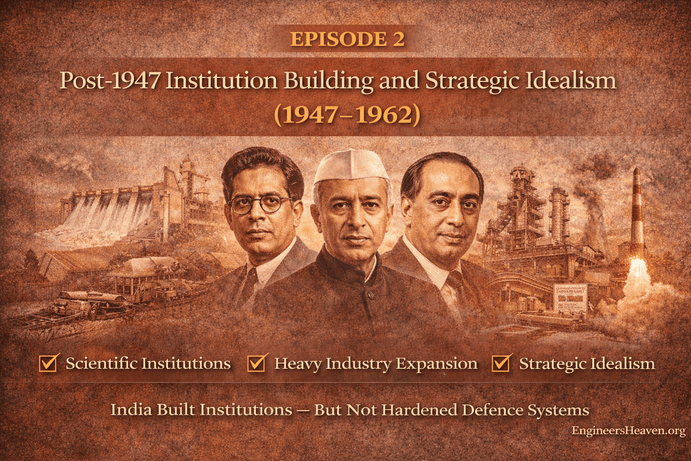
EPISODE 2 Post-1947 Institution Building and Strategic Idealism (1947–1962)
15 August 1947 — India became politically independent.
But sovereignty requires more than flags and constitutions.
It requires:
Scientific institutions
Industrial depth
Strategic clarity
Military preparedness
Between 1947 and 1962, India built powerful institutions — yet strategic idealism often outpaced military modernization.
1️⃣ Nehruvian Scientific StatecraftPrime Minister Jawaharlal Nehru viewed science as the foundation of modern India.
He famously called dams and laboratories the “temples of modern India.”
Key Institutional Milestones1948 – Atomic Energy Commission (AEC)
Chaired by Homi Jehangir Bhabha [1]
1954 – Department of Atomic Energy (DAE) [2]
1958 – Defence Research and Development Organisation (DRDO) [3]
These institutions created structured scientific governance within a young republic.
2️⃣ The Bhabha Nuclear VisionHomi Bhabha proposed a three-stage nuclear power program in the 1950s [4]:
Pressurized Heavy Water Reactors (PHWRs)
Fast Breeder Reactors
Thorium-based reactors
India possessed limited uranium but large thorium reserves.
Bhabha designed a long-term resource-based strategy decades ahead of global energy security debates.
3️⃣ Industrial Policy & Heavy Engineering ExpansionUnder the Second Five-Year Plan (1956–1961), architected by P. C. Mahalanobis, India emphasized:
Heavy machinery
Public sector steel plants
Infrastructure development
Major steel plants established with foreign collaboration:
Bhilai (USSR)
Rourkela (Germany)
Durgapur (UK)
(Planning Commission Records, 1956) [5]
Industrial depth expanded — but defence manufacturing integration remained limited.
4️⃣ DRDO Formation (1958)DRDO was created by merging:
Technical Development Establishment (TDEs)
Directorate of Technical Development and Production (DTDP)
[3]
Initial focus areas:
Armaments
Combat engineering
Military communications
However, funding and systems integration capacity were modest during this period.
5️⃣ Strategic Idealism & Panchsheel (1954)India signed the Panchsheel Agreement with China in 1954 [6].
Core principles:
Mutual respect
Non-aggression
Non-interference
India pursued Non-Alignment — balancing Cold War blocs without formal alliances.
Military modernization did not accelerate proportionately.
Strategic assessment underestimated Chinese infrastructure buildup in Tibet (Maxwell, 1970) [7].
6️⃣ The 1962 Sino-Indian War: Systemic Shock October–November 1962China launched coordinated offensives across:
Aksai Chin
NEFA (now Arunachal Pradesh)
Political Leadership:
Prime Minister Jawaharlal Nehru
Defence Minister:
V. K. Krishna Menon
(Official History of the 1962 War, Government of India) [8]
Engineering and structural weaknesses exposed:
Inadequate mountain warfare logistics
Insufficient high-altitude equipment
Poor intelligence integration
Weak air power utilization
1962 was not merely a battlefield defeat.
It was a systems failure.
Structural Assessment (1947–1962) Achievements✔ Creation of Atomic Energy Commission (1948)
✔ Establishment of DRDO (1958)
✔ Heavy industry expansion
✔ Institutional scientific governance
✔ Nuclear research roadmap
✖ Underinvestment in operational defence modernization
✖ Strategic overreliance on diplomacy
✖ Weak border infrastructure
✖ Limited integration between R&D and armed forces
1947–1962 was the era of institutional optimism.
India built laboratories, reactors, steel plants, and research councils.
But it did not yet build hardened defence systems aligned with geopolitical realities.
The 1962 war forced the transition from idealism to realism.
That transition defines Episode 3.
