User Ideas / Prospects

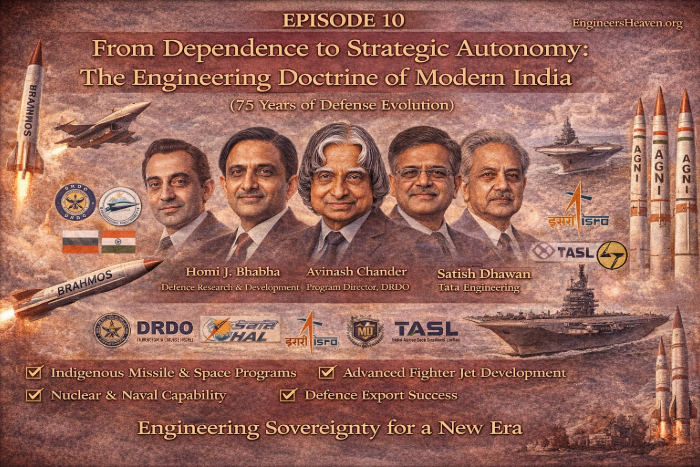
Post-independence India inherited:
Minimal indigenous defense manufacturing capability
Heavy reliance on British and Soviet platforms
Limited R&D ecosystem
Fragmented industrial base
For decades, India operated largely as a buyer nation.
But the 1998 nuclear tests and post-Kargil realities forced a structural shift:
Strategic autonomy is impossible without technological autonomy.
This episode examines how engineering institutions converted that doctrine into executable capability.
2. Structural Reforms That Changed the Game A. Corporatization & Industrial ReformOrdnance Factory Board restructured into 7 DPSUs (2021)
Increased private sector participation
Liberalized FDI norms in defense manufacturing
Strategic Partnership Model
This was not merely administrative reform — it was supply-chain re-engineering at national scale.
B. Rise of Integrated Military-Industrial EcosystemKey institutional pillars:
Defence Research and Development Organisation
Hindustan Aeronautics Limited
Bharat Electronics Limited
Bharat Dynamics Limited
Larsen & Toubro
Tata Advanced Systems Limited
This network now spans:
Missile systems
Naval shipbuilding
Radar & EW
Fighter aircraft assembly
Space-defense convergence
Agni series operationalization
Submarine-launched ballistic capability
Hypersonic research
Indigenous air defense systems
Strategic Forces Command + DRDO = credible deterrence architecture.
AerospaceTejas induction
Indigenous AEW&C systems
UAV programs
Engine development programs (Kaveri derivatives, joint initiatives)
Indigenous aircraft carriers
Nuclear submarine fleet
Advanced destroyers & frigates
BrahMos naval integration
Secure communication networks
Indigenous radars
Battlefield management systems
Electronic warfare platforms
Modern warfare is system-of-systems engineering — and India is now building entire stacks, not components.
4. Strategic International Engineering PartnershipsIndia moved from buyer to co-developer.
Notable ExamplesBrahMos Aerospace (with Russia)
Dassault Aviation collaboration (Rafale ecosystem)
Licensed production of MiG & Sukhoi platforms
Technology absorption and reverse engineering cycles
The difference today:
Earlier: screwdriver technology
Now: joint R&D, co-production, export variants
India is now exporting:
BrahMos to Southeast Asia
Artillery systems
Radar systems
Patrol vessels
UAV platforms
Defense exports crossed multi-billion USD levels recently — a historic milestone.
Engineering credibility is now translating into geopolitical leverage.
6. The Engineers Behind the DoctrineAcross eras, leadership mattered:
Homi J. Bhabha — Strategic nuclear foundation
Vikram Sarabhai — Space-defense ecosystem roots
A. P. J. Abdul Kalam — Missile doctrine architect
Satish Dhawan — Institutional R&D culture
Naval and aerospace program directors who executed carrier and submarine programs
Missile complex directors who operationalized Agni
This is not personality glorification.
It is acknowledgement of systems leadership in engineering.
7. The Remaining GapsStrategic autonomy is incomplete without:
Indigenous jet engine mastery
Advanced semiconductor capability
Complete supply chain indigenization
Deep materials research (superalloys, composites)
Long-cycle R&D funding stability
These are engineering problems — not political slogans.
8. The Real TransformationIndia’s defense evolution can be mapped in 5 phases:
Import dependence
Licensed assembly
Component-level localization
System integration
Full-spectrum design & export capability
We are currently transitioning between Phase 4 and Phase 5.
That is historically significant.
Closing ReflectionDefense engineering is not about weapons.
It is about sovereignty.
It is about ensuring that political decisions are not constrained by technological dependence.
And most importantly:
It is about engineers who built systems quietly, without media glamour, across decades.
