User Ideas / Prospects

EPISODE 8 Strategic Partnerships, Technology Transfer & India’s Hybrid Defence Autonomy (2000–Present) 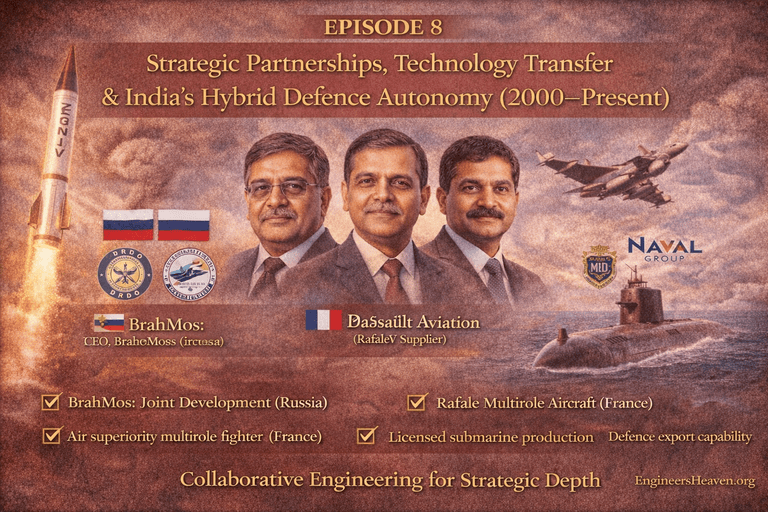 I. Strategic Context: Modernization Under Constraint
By the late 1990s, India had:
Demonstrated nuclear capability (1998)
Developed indigenous missile systems
Built a large but aging Soviet-origin arsenal
However, three structural challenges remained:
Air power obsolescence
Naval underwater capability gaps
Precision-strike modernization needs
Simultaneously, Western sanctions and technology denial regimes restricted access to high-end military systems.
India’s response was not isolationism.
It adopted a hybrid defence autonomy model:
Joint development where possible
Licensed production where necessary
High-end procurement where urgent
Progressive technology absorption
Episode 8 documents this transition.
II. BrahMos: Co-Development as Strategic Leverage The Joint Venture
In 1998, India and Russia created:
BrahMos Aerospace
Partners:
Defence Research and Development Organisation
NPO Mashinostroyenia
This was not a buyer-seller contract.
It was a joint engineering enterprise.
Engineering Achievements
Speed: Mach 2.8–3.0
Range: Initially ~290 km (MTCR-limited); extended versions beyond 400 km
Variants: Land, sea, submarine, and air-launched (Su-30MKI integration)
Precision strike capability
Unlike subsonic cruise missiles, BrahMos compresses reaction time for adversaries.
It altered tactical doctrine in the Indian Ocean and along continental borders.
Key Contributors
A. Sivathanu Pillai – Founding CEO & Managing Director
Russian design leadership from NPO Mashinostroyenia
DRDO propulsion, guidance, and integration teams
Strategically significant milestone:
India exported BrahMos to the Philippines in 2022 — marking its emergence as a defence exporter.
This represents engineering sovereignty matured into export credibility.
III. Air Power Modernization: Beyond Soviet Legacy 1. Su-30MKI – Multinational Systems Fusion
Platform Origin:
Sukhoi
Licensed production:
Hindustan Aeronautics Limited
Distinctive Engineering Feature:
The Su-30MKI is not a standard Russian aircraft.
It integrates:
Indian mission computers
Israeli avionics
French subsystems
Russian airframe & engines
This is complex systems integration engineering — a core sovereign capability.
HAL’s licensed manufacturing built deep competencies in:
Airframe assembly
Systems integration
Maintenance, repair, and overhaul (MRO)
Lifecycle support
India transitioned from operator to producer-integrator.
2. Rafale – Strategic Capability Leap
Supplier:
Dassault Aviation
Agreement signed: 2016
Aircraft inducted: 36
Engineering Capabilities Added
AESA radar
Meteor beyond-visual-range missile
SCALP cruise missile
SPECTRA electronic warfare suite
Nuclear delivery capability
Rafale did not merely add aircraft numbers.
It upgraded India’s:
Air dominance envelope
Electronic warfare capability
Precision deep-strike ability
It closed qualitative gaps.
IV. Submarine Capability: Indigenous Construction with Foreign Design Scorpene-Class (Kalvari-Class)
Design Partner:
Naval Group
Built at:
Mazagon Dock Shipbuilders Limited
This program transferred:
Submarine hull construction techniques
Combat management integration
Stealth design knowledge
Complex dockyard capability
India did not merely purchase submarines.
It built them domestically under technology transfer.
This strengthened long-term naval industrial capacity.
V. Strategic Pattern: From Importer to Hybrid Sovereign
Across these programs, a structural pattern emerges:
Phase Model Outcome| 1970s–1990s | Heavy imports | Operational capability |
| 2000s | Licensed production | Industrial skill development |
| 2010s | Joint development | Shared intellectual property |
| 2020s | Export capability | Strategic leverage |
India’s defence ecosystem now includes:
Co-development (BrahMos)
Licensed manufacturing (Su-30MKI)
High-end acquisition (Rafale)
Indigenous shipbuilding (Scorpene)
Emerging exports
This is not dependency.
It is calibrated interdependence with strategic insulation.
VI. Decision-Makers & Strategic Leadership
While thousands of engineers executed these programs, policy direction mattered.
Political and institutional leadership across successive governments enabled:
Strategic alignment with Russia and France
Post-sanctions technology negotiations
Reform of procurement pathways
Promotion of defence exports
Institutional actors included:
DRDO scientific leadership
HAL and MDL engineering teams
Armed Forces doctrine planners
Ministry of Defence acquisition divisions
Engineering execution remained the backbone.
VII. National Consequence
India’s defence posture today reflects:
Supersonic cruise missile deterrence
Air superiority modernization
Strengthened submarine fleet
Export-oriented defence manufacturing
Most importantly:
India moved from being a passive importer
to becoming an engineering participant in global defence ecosystems.
This is strategic maturity.
Closing Reflection
Defence sovereignty in the 21st century does not mean isolation.
It means:
Knowing what to build
Knowing what to co-develop
Knowing what to absorb
And knowing what to export
Episode 8 marks the consolidation phase of India’s defence engineering evolution.
