1998–Present: Deterrence Consolidation, Structural Reform, and the Rise of Atmanirbhar Defence from Engineers Heaven's Idea / Prospect
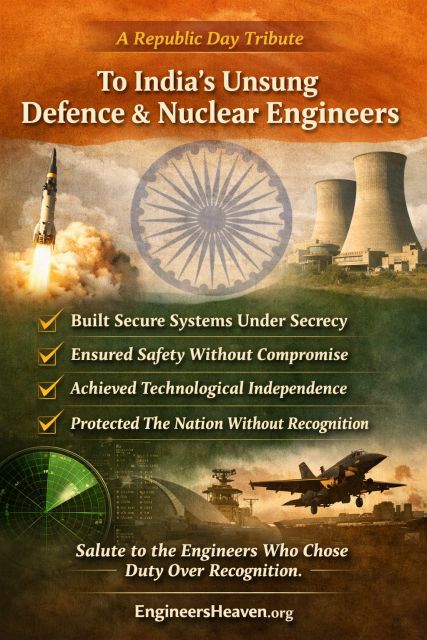
Pokhran-II (May 1998) declared India a nuclear weapons state (Government of India Statements, 1998).
But declaration is not deterrence.
Deterrence requires:
Delivery systems
Command-and-control architecture
Political doctrine
Industrial depth
Operational validation
Between 1998 and today, India built that architecture.
1. 1999 – Kargil War: Operational Stress Test May–July 1999
The Kargil conflict exposed:
Intelligence gaps
Surveillance weaknesses
High-altitude logistics challenges
(Raghavan, 2016)
Political Leadership:
Prime Minister Atal Bihari Vajpayee
Military Leadership:
Army Chief Gen. V. P. Malik
Air Chief Marshal A. Y. Tipnis
Engineering consequences:
Acceleration of UAV acquisition
Precision artillery upgrades
Surveillance modernization
Kargil became the post-nuclear operational validation phase.
2. 1999–2003: Nuclear Doctrine & Command Structure 1999 – Draft Nuclear Doctrine 2003 – Official Nuclear Doctrine
India formalized:
Credible Minimum Deterrence
No First Use (NFU)
Civilian political control over nuclear arsenal
(Government of India, 1999 Draft Doctrine; 2003 Cabinet Committee on Security Statement)
2003 – Strategic Forces Command (SFC) Established
This institutionalized nuclear command-and-control architecture.
Deterrence became structured, not symbolic.
3. Missile Maturation (2000s)
Under DRDO leadership and continued missile programs:
Agni-II operationalized (early 2000s)
Agni-III and later variants extended range capability
Prithvi variants refined
(DRDO Official Reports)
Key technical domains matured:
Re-entry vehicle materials
Solid propulsion optimization
Ring laser gyro navigation
Advanced guidance systems
Missile capability shifted from demonstration to deployment.
4. Civil Nuclear Diplomacy Breakthrough 2005–2008: India–U.S. Civil Nuclear Agreement
Political Leadership:
Prime Minister Manmohan Singh
U.S. President George W. Bush
2008 NSG Waiver allowed India civilian nuclear trade access (Tellis, 2011).
This was strategic normalization without signing NPT.
India moved from sanctioned isolation to conditional integration.
5. Indigenous Strategic Platforms INS Arihant (Launched 2009; Commissioned 2016)
India’s first indigenous nuclear-powered ballistic missile submarine.
Represents:
Sea-based deterrence
Completion of nuclear triad
(Indian Navy Official Statements)
Sea leg of deterrence is crucial for second-strike credibility.
6. Aerospace & Space Militarization 2007 – Agni-III Test 2012 – Agni-V Long-Range Test
(DRDO Archives)
2019 – Mission Shakti (Anti-Satellite Test)
Under Prime Minister Narendra Modi
India demonstrated anti-satellite capability (Government of India Statement, 2019).
This marked entry into space security domain.
7. Structural Reform: Chief of Defence Staff 2019 – Creation of Chief of Defence Staff (CDS)
First CDS:
General Bipin Rawat
This reform aimed to:
Improve tri-service integration
Strengthen joint operational planning
Enhance procurement efficiency
(Government of India Notification, 2019)
Institutional integration deepened.
8. Atmanirbhar Bharat & Defence Industrial Reform Post-2014: Defence Manufacturing Push
Key reforms:
Strategic Partnership Model
Increased FDI in defence sector
Defence corridors (Tamil Nadu, Uttar Pradesh)
Import negative lists
Domestic procurement prioritization
(Ministry of Defence Annual Reports)
Private sector participation expanded:
L&T
Tata Advanced Systems
Bharat Forge
Mahindra Defence
Defence production ecosystem diversified beyond DPSUs.
9. Indigenous Platforms of the 2010s–2020s
LCA Tejas operational induction (HAL Reports)
Dhanush artillery system
Pinaka multi-barrel rocket launcher
BrahMos supersonic cruise missile (India–Russia JV)
Advanced radar and electronic warfare systems
Engineering now spans:
Electronics
Materials science
Propulsion
Cyber capabilities
Space domain awareness
Structural Assessment (1998–Present)
Achievements:
✔ Nuclear doctrine institutionalized (1999/2003 Doctrine)
✔ Strategic Forces Command operationalized
✔ Nuclear triad established (INS Arihant)
✔ Long-range missile capability matured
✔ Space deterrence demonstrated (2019 ASAT)
✔ Defence industrial reform initiated
✔ Private sector participation increased
Limitations:
✖ Jet engine dependency persists
✖ Semiconductor and microelectronics vulnerability
✖ High-end propulsion technology gap
✖ Import reliance not fully eliminated
Core Insight
1998 declared deterrence.
1999 structured doctrine.
2003 institutionalized command.
2008 normalized diplomacy.
2016 completed nuclear triad.
2019 entered space deterrence.
Post-2014 industrial reforms attempt structural autonomy.
India is no longer building symbolic capability.
It is engineering layered deterrence across land, air, sea, and space.

The Wall