EPISODE 5: Liberalization and Dual-Use Technology Growth (1991–1998) from Engineers Heaven's Idea / Prospect
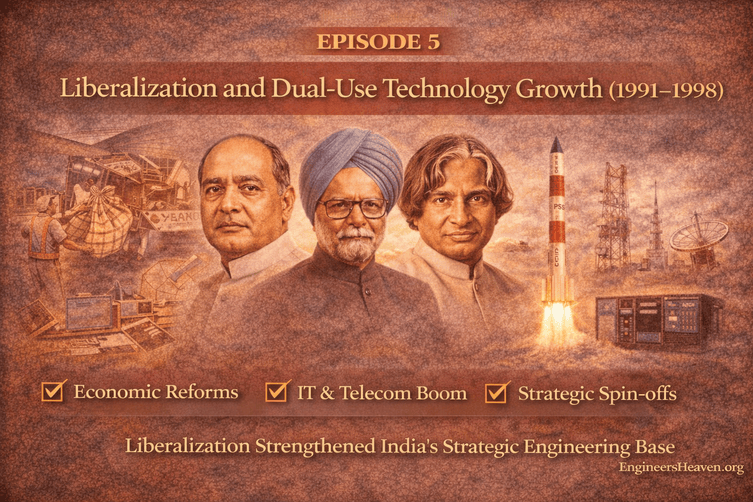
EPISODE 5 Liberalization and Dual-Use Technology Growth (1991–1998)
July 1991.
India faced a balance-of-payments crisis.
Foreign exchange reserves fell to the equivalent of two weeks of imports.
Gold was airlifted to secure emergency loans.
But from crisis emerged structural transformation.
This episode examines how economic liberalization reshaped India’s technological base — and indirectly strengthened strategic capability.
1️⃣ 1991 Economic Reforms: Structural Reset 24 July 1991 – New Industrial Policy Announced
Prime Minister:
P. V. Narasimha Rao
Finance Minister:
Manmohan Singh
Key reforms [1]:
Industrial licensing dismantled
Foreign direct investment liberalized
Public sector monopolies reduced
Trade barriers lowered
For the first time since independence, private capital gained systemic industrial space.
This mattered for defence — even if indirectly.
2️⃣ Rise of the IT Sector
1990s reforms catalyzed software exports and computing services.
Key corporate actors:
Infosys
Tata Consultancy Services
Wipro
Technology infrastructure expanded:
Software engineering ecosystem
Electronics manufacturing
Telecom modernization
The result:
Dual-use capability growth.
Software written for global corporations strengthened domestic simulation, encryption, and command systems capability.
3️⃣ Telecommunications Expansion 1994 – National Telecom Policy [2]
Telecom liberalization accelerated:
Private participation
Infrastructure modernization
Digital switching systems
Telecom networks later became critical for:
Secure communications
Satellite uplinks
Defence networking
Civilian growth strengthened strategic backbone.
4️⃣ Missile Program Maturation
The 1990s saw continued progress under IGMDP.
11 April 1999 – Agni-II (Beyond this episode's window, but built on 1990s groundwork)
Earlier tests in 1990s validated incremental advancements [3].
Leadership continuity:
A. P. J. Abdul Kalam
The engineering ecosystem now had:
Stronger private suppliers
Electronics manufacturing support
Materials industry depth
Liberalization improved supply chains.
5️⃣ Satellite and Launch Vehicle Progress
ISRO advanced:
PSLV development (first successful launch: 15 October 1994) [4]
IRS satellite systems
Civilian space capability increased:
Earth observation
Launch autonomy
Navigation groundwork
Dual-use implications were obvious.
6️⃣ Nuclear Continuity and Strategic Debate
Through the 1990s, nuclear capability remained undeclared but active.
Political leadership in 1998 would formalize it.
But groundwork — technical and industrial — was laid during 1991–1998.
Structural Assessment (1991–1998) Achievements
✔ Industrial liberalization
✔ IT ecosystem emergence
✔ Telecom infrastructure expansion
✔ PSLV success
✔ Strengthened missile supply chains
Limitations
✖ Defence production still largely state-controlled
✖ Advanced microelectronics dependency remained
✖ No formalized nuclear doctrine
Core Insight
1974–1991 built resilience under sanctions.
1991–1998 built economic velocity.
Liberalization did not directly target defence.
But it expanded:
Capital flow
Talent mobility
Industrial sophistication
Systems engineering capacity
When the next strategic assertion came, India was economically stronger.
That assertion defines Episode 6.
???? Reference List
[1] Government of India – New Industrial Policy (24 July 1991)
[2] National Telecom Policy (1994)
[3] DRDO Archives – IGMDP Progress Reports (1990s)
[4] ISRO – PSLV-C2 Success (15 October 1994)

The Wall