engineersheaven's Idea / Prospect
.png)
How did India become a technologically capable defense power?
Missiles.
Aircraft carriers.
Nuclear capability.
Advanced radar and missile systems.
These achievements did not appear suddenly.
They are the result of decades of engineering, scientific research, strategic decision-making, and institutional development carried out by generations of Indian engineers and scientists.
To explore this journey, we created a 10-episode research series on EngineersHeaven.org that explains how India built its defense technology ecosystem.
Engineering India's Defense: Technology, Strategy, and Nation Building
Episode 1 — Pre-Independence Industrial and Scientific Foundations
Episode 2 — Post-1947 Institution Building and Strategic Idealism
Episode 3 — Technological Shock and Strategic Realism
Episode 4 — Sanctions and Indigenous Engineering
Episode 5 — Liberalization and Dual-Use Technology Growth
Episode 6 — Strategic Systems Development
Episode 7 — Integrated Defense Ecosystem
Episode 8 — Strategic Defense Partnerships
Episode 9 — Global Collaboration and Capability Expansion
Episode 10 — Strategic Autonomy and the Modern Defense Ecosystem
This series highlights not just geopolitical events, but the engineers, scientists, and institutions that quietly built technological capability for the nation.
Explore the complete article series on EngineersHeaven.org
If you believe engineers play a critical role in shaping nations, this story deserves to be told.
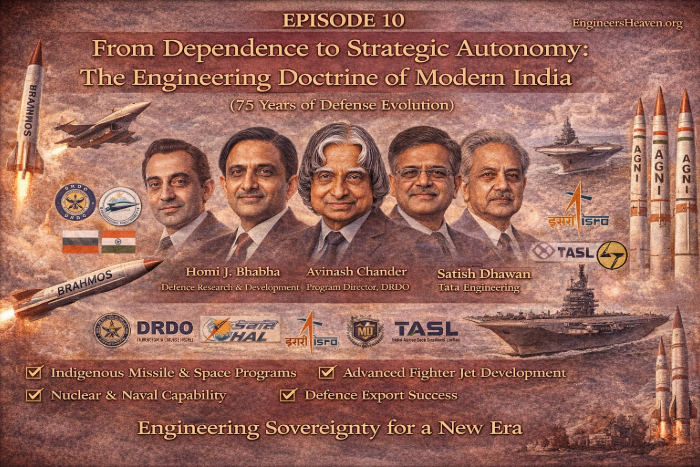
Post-independence India inherited:
Minimal indigenous defense manufacturing capability
Heavy reliance on British and Soviet platforms
Limited R&D ecosystem
Fragmented industrial base
For decades, India operated largely as a buyer nation.
But the 1998 nuclear tests and post-Kargil realities forced a structural shift:
Strategic autonomy is impossible without technological autonomy.
This episode examines how engineering institutions converted that doctrine into executable capability.
2. Structural Reforms That Changed the Game A. Corporatization & Industrial ReformOrdnance Factory Board restructured into 7 DPSUs (2021)
Increased private sector participation
Liberalized FDI norms in defense manufacturing
Strategic Partnership Model
This was not merely administrative reform — it was supply-chain re-engineering at national scale.
B. Rise of Integrated Military-Industrial EcosystemKey institutional pillars:
Defence Research and Development Organisation
Hindustan Aeronautics Limited
Bharat Electronics Limited
Bharat Dynamics Limited
Larsen & Toubro
Tata Advanced Systems Limited
This network now spans:
Missile systems
Naval shipbuilding
Radar & EW
Fighter aircraft assembly
Space-defense convergence
Agni series operationalization
Submarine-launched ballistic capability
Hypersonic research
Indigenous air defense systems
Strategic Forces Command + DRDO = credible deterrence architecture.
AerospaceTejas induction
Indigenous AEW&C systems
UAV programs
Engine development programs (Kaveri derivatives, joint initiatives)
Indigenous aircraft carriers
Nuclear submarine fleet
Advanced destroyers & frigates
BrahMos naval integration
Secure communication networks
Indigenous radars
Battlefield management systems
Electronic warfare platforms
Modern warfare is system-of-systems engineering — and India is now building entire stacks, not components.
4. Strategic International Engineering PartnershipsIndia moved from buyer to co-developer.
Notable ExamplesBrahMos Aerospace (with Russia)
Dassault Aviation collaboration (Rafale ecosystem)
Licensed production of MiG & Sukhoi platforms
Technology absorption and reverse engineering cycles
The difference today:
Earlier: screwdriver technology
Now: joint R&D, co-production, export variants
India is now exporting:
BrahMos to Southeast Asia
Artillery systems
Radar systems
Patrol vessels
UAV platforms
Defense exports crossed multi-billion USD levels recently — a historic milestone.
Engineering credibility is now translating into geopolitical leverage.
6. The Engineers Behind the DoctrineAcross eras, leadership mattered:
Homi J. Bhabha — Strategic nuclear foundation
Vikram Sarabhai — Space-defense ecosystem roots
A. P. J. Abdul Kalam — Missile doctrine architect
Satish Dhawan — Institutional R&D culture
Naval and aerospace program directors who executed carrier and submarine programs
Missile complex directors who operationalized Agni
This is not personality glorification.
It is acknowledgement of systems leadership in engineering.
7. The Remaining GapsStrategic autonomy is incomplete without:
Indigenous jet engine mastery
Advanced semiconductor capability
Complete supply chain indigenization
Deep materials research (superalloys, composites)
Long-cycle R&D funding stability
These are engineering problems — not political slogans.
8. The Real TransformationIndia’s defense evolution can be mapped in 5 phases:
Import dependence
Licensed assembly
Component-level localization
System integration
Full-spectrum design & export capability
We are currently transitioning between Phase 4 and Phase 5.
That is historically significant.
Closing ReflectionDefense engineering is not about weapons.
It is about sovereignty.
It is about ensuring that political decisions are not constrained by technological dependence.
And most importantly:
It is about engineers who built systems quietly, without media glamour, across decades.
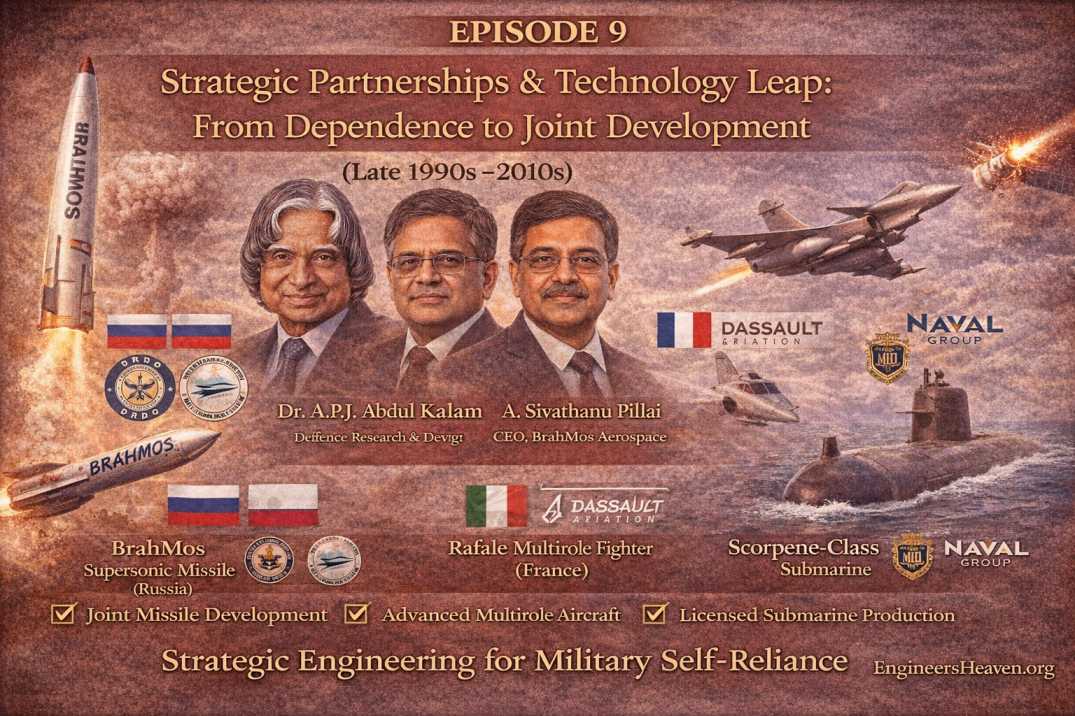
If earlier episodes established indigenous capability, Episode 9 examines a critical reality:
India’s defense rise was not built in isolation — it was engineered through calibrated strategic partnerships.
This phase marks India’s shift:
From pure import dependence
To licensed production
To joint development
Toward technology absorption and strategic autonomy
The BrahMos Aerospace joint venture (1998) between:
India’s DRDO
Russia’s NPO Mashinostroyenia
Produced the BrahMos — the world’s fastest operational supersonic cruise missile.
Why This Was Strategic:First true Indo-Russian joint missile development
Supersonic precision strike capability
Naval, land, and air variants
Export potential opened (Philippines deal)
Dr. A.P.J. Abdul Kalam – Strategic visionary behind missile ecosystem
Dr. Sivathanu Pillai – Founding CEO & execution architect
Russian missile design leadership from NPO
This model proved India could:
Co-develop, not merely buy.
2️⃣ Aircraft Evolution – From MiG Dependence to Rafale Acquisition MiG LegacyFor decades, India operated aircraft from:
Mikoyan (MiG-21, MiG-29)
Licensed production via Hindustan Aeronautics Limited (HAL) enabled:
Domestic manufacturing
Maintenance autonomy
Engineering skill transfer
However, aging fleets and accident concerns pushed modernization.
The Rafale Deal (France)India signed a contract for 36 Rafale jets from:
Dassault Aviation
French government strategic backing
Advanced avionics
Meteor long-range air-to-air missiles
SCALP cruise missiles
Electronic warfare superiority
Finalized under Prime Minister Narendra Modi
IAF technical evaluation teams
Defence Acquisition Council
This marked:
Capability-first procurement over incremental upgrades.
3️⃣ Naval Power & Technology Transfer Aircraft Carrier EvolutionAfter INS Vikrant (legacy), India operated:
INS Vikramaditya (refitted from Russian Admiral Gorshkov)
Involved collaboration with:
Sevmash
Indian naval engineers
Cochin Shipyard ecosystem (indigenous strengthening)
This transition later enabled:
Indigenous carrier capability (future episode focus)
India partnered with:
Naval Group
To build Kalvari-class submarines at:
Mazagon Dock Shipbuilders Limited
Key Objectives:
Stealth submarine tech
Indigenous assembly
Naval ecosystem strengthening
This period was not about glamour.
It was about structural transformation:
Phase |
Nature |
1960s–80s |
Imports |
1980s–90s |
Licensed Production |
1998–2015 |
Joint Development |
Post-2015 |
Strategic Autonomy Push |
India learned:
Negotiation leverage
Offset clauses
Technology absorption
Industrial ecosystem scaling
This era required:
Aerospace systems engineers
Naval architects
Missile propulsion experts
Metallurgical specialists
Radar & avionics engineers
Strategic negotiators
Defense is not just policy.
It is systems integration at a national scale.
Episode 9 ConclusionIf Episode 7 was about internal capability
And Episode 8 about strategic deterrence
Episode 9 shows India mastering partnership without surrendering sovereignty.
This phase laid the groundwork for:
Make in India (Defense)
Indigenous aircraft carrier
LCA Tejas expansion
Hypersonic research
Export-oriented defense manufacturing
EPISODE 8 Strategic Partnerships, Technology Transfer & India’s Hybrid Defence Autonomy (2000–Present) 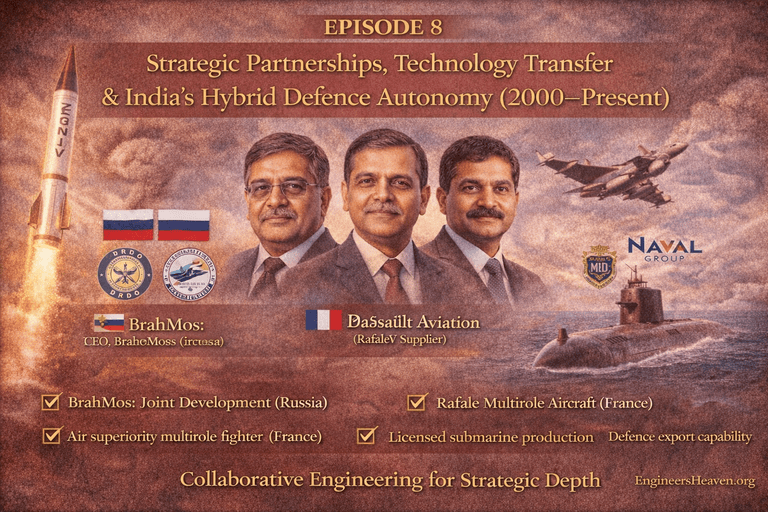 I. Strategic Context: Modernization Under Constraint
By the late 1990s, India had:
Demonstrated nuclear capability (1998)
Developed indigenous missile systems
Built a large but aging Soviet-origin arsenal
However, three structural challenges remained:
Air power obsolescence
Naval underwater capability gaps
Precision-strike modernization needs
Simultaneously, Western sanctions and technology denial regimes restricted access to high-end military systems.
India’s response was not isolationism.
It adopted a hybrid defence autonomy model:
Joint development where possible
Licensed production where necessary
High-end procurement where urgent
Progressive technology absorption
Episode 8 documents this transition.
II. BrahMos: Co-Development as Strategic Leverage The Joint Venture
In 1998, India and Russia created:
BrahMos Aerospace
Partners:
Defence Research and Development Organisation
NPO Mashinostroyenia
This was not a buyer-seller contract.
It was a joint engineering enterprise.
Engineering Achievements
Speed: Mach 2.8–3.0
Range: Initially ~290 km (MTCR-limited); extended versions beyond 400 km
Variants: Land, sea, submarine, and air-launched (Su-30MKI integration)
Precision strike capability
Unlike subsonic cruise missiles, BrahMos compresses reaction time for adversaries.
It altered tactical doctrine in the Indian Ocean and along continental borders.
Key Contributors
A. Sivathanu Pillai – Founding CEO & Managing Director
Russian design leadership from NPO Mashinostroyenia
DRDO propulsion, guidance, and integration teams
Strategically significant milestone:
India exported BrahMos to the Philippines in 2022 — marking its emergence as a defence exporter.
This represents engineering sovereignty matured into export credibility.
III. Air Power Modernization: Beyond Soviet Legacy 1. Su-30MKI – Multinational Systems Fusion
Platform Origin:
Sukhoi
Licensed production:
Hindustan Aeronautics Limited
Distinctive Engineering Feature:
The Su-30MKI is not a standard Russian aircraft.
It integrates:
Indian mission computers
Israeli avionics
French subsystems
Russian airframe & engines
This is complex systems integration engineering — a core sovereign capability.
HAL’s licensed manufacturing built deep competencies in:
Airframe assembly
Systems integration
Maintenance, repair, and overhaul (MRO)
Lifecycle support
India transitioned from operator to producer-integrator.
2. Rafale – Strategic Capability Leap
Supplier:
Dassault Aviation
Agreement signed: 2016
Aircraft inducted: 36
Engineering Capabilities Added
AESA radar
Meteor beyond-visual-range missile
SCALP cruise missile
SPECTRA electronic warfare suite
Nuclear delivery capability
Rafale did not merely add aircraft numbers.
It upgraded India’s:
Air dominance envelope
Electronic warfare capability
Precision deep-strike ability
It closed qualitative gaps.
IV. Submarine Capability: Indigenous Construction with Foreign Design Scorpene-Class (Kalvari-Class)
Design Partner:
Naval Group
Built at:
Mazagon Dock Shipbuilders Limited
This program transferred:
Submarine hull construction techniques
Combat management integration
Stealth design knowledge
Complex dockyard capability
India did not merely purchase submarines.
It built them domestically under technology transfer.
This strengthened long-term naval industrial capacity.
V. Strategic Pattern: From Importer to Hybrid Sovereign
Across these programs, a structural pattern emerges:
Phase Model Outcome| 1970s–1990s | Heavy imports | Operational capability |
| 2000s | Licensed production | Industrial skill development |
| 2010s | Joint development | Shared intellectual property |
| 2020s | Export capability | Strategic leverage |
India’s defence ecosystem now includes:
Co-development (BrahMos)
Licensed manufacturing (Su-30MKI)
High-end acquisition (Rafale)
Indigenous shipbuilding (Scorpene)
Emerging exports
This is not dependency.
It is calibrated interdependence with strategic insulation.
VI. Decision-Makers & Strategic Leadership
While thousands of engineers executed these programs, policy direction mattered.
Political and institutional leadership across successive governments enabled:
Strategic alignment with Russia and France
Post-sanctions technology negotiations
Reform of procurement pathways
Promotion of defence exports
Institutional actors included:
DRDO scientific leadership
HAL and MDL engineering teams
Armed Forces doctrine planners
Ministry of Defence acquisition divisions
Engineering execution remained the backbone.
VII. National Consequence
India’s defence posture today reflects:
Supersonic cruise missile deterrence
Air superiority modernization
Strengthened submarine fleet
Export-oriented defence manufacturing
Most importantly:
India moved from being a passive importer
to becoming an engineering participant in global defence ecosystems.
This is strategic maturity.
Closing Reflection
Defence sovereignty in the 21st century does not mean isolation.
It means:
Knowing what to build
Knowing what to co-develop
Knowing what to absorb
And knowing what to export
Episode 8 marks the consolidation phase of India’s defence engineering evolution.
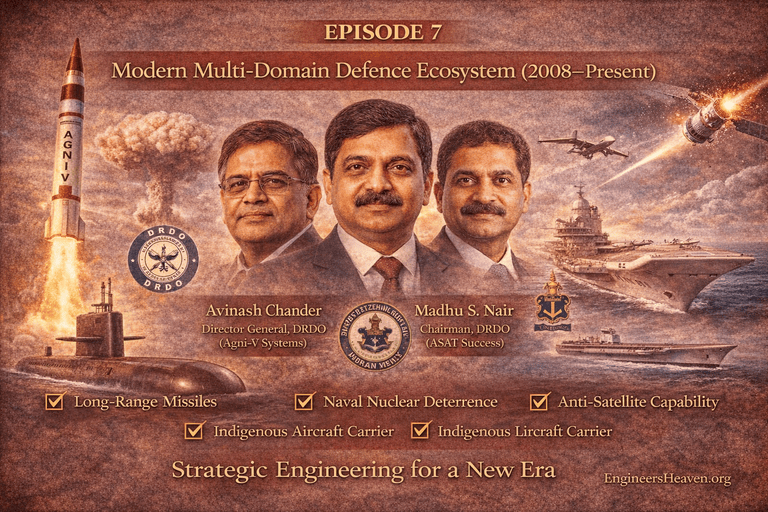
This phase is not about single platforms.
It is about ecosystem integration.
From 2008 onward, India transitions toward:
Network-centric warfare
Space militarization
Indigenous production scaling
Private sector integration
Strategic autonomy 2.0
India re-enters global nuclear commerce.
Result:
Access to uranium imports
Civil nuclear expansion
Strategic breathing space
But unlike earlier decades, India now pushes for indigenous depth simultaneously.
2️⃣ Ballistic Missile Defence & Advanced MissilesKey systems matured post-2008:
Agni-IV
Agni-V (first tested 19 April 2012)
Advanced Air Defence (AAD) interceptor
Agni-V extended range into intercontinental category.
India now operates credible long-range deterrence.
3️⃣ Naval Nuclear Triad Completion 2009 – INS Arihant Launched 2016 – Commissioned into serviceIndia operationalizes sea-based nuclear deterrence.
Nuclear triad becomes functional:
Land-based missiles
Air-delivered capability
Sea-based deterrence
This marks structural completion of minimum deterrence doctrine.
4️⃣ Space Militarization Phase 27 March 2019 – Mission Shakti (ASAT Test)India demonstrated anti-satellite capability.
India became the fourth nation to conduct a successful ASAT test.
Space is now recognized as a military domain.
5️⃣ Defence Industrial Policy Shift 2014 onward – “Make in India” defence pushKey transitions:
Increased FDI limits
Strategic partnership model
Private sector inclusion
Indigenous fighter, artillery, drone programs
Defence exports rise significantly post-2018.
India moves from buyer to partial exporter.
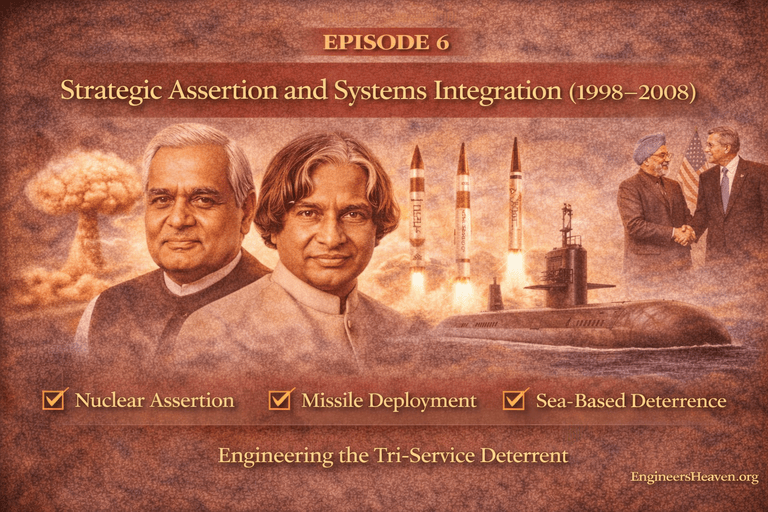 EPISODE 6 Strategic Assertion and Systems Integration (1998–2008)
11 May 1998 — Pokhran-II.
India moved from nuclear ambiguity to declared nuclear weapons state.
This episode is about transition from capability to doctrine.
1️⃣ Pokhran-II: The Overt Declaration 11 & 13 May 1998 – Five Nuclear Tests(Operation Shakti)
Prime Minister:
Atal Bihari Vajpayee
Scientific Leadership:
A. P. J. Abdul Kalam
R. Chidambaram
India tested:
Fission device
Thermonuclear design
Sub-kiloton devices
Immediate consequences:
U.S. sanctions (Glenn Amendment)
Japanese financial restrictions
Multilateral diplomatic pressure
But unlike 1974 — India’s economy was stronger.
Sanctions did not paralyze.
2️⃣ Formal Nuclear Doctrine Draft Nuclear Doctrine – 1999 Official Nuclear Doctrine – January 2003Key Elements:
Credible Minimum Deterrence
No First Use policy
Massive retaliation principle
Civilian political control
This marks transition from engineering capability to strategic framework.
3️⃣ Kargil Conflict: Operational Test of Systems May–July 1999 – Kargil WarPrime Minister:
Atal Bihari Vajpayee
Army Leadership:
Gen. V. P. Malik
Lessons:
Surveillance gaps exposed
Precision munitions importance highlighted
Need for jointness intensified
Post-Kargil Reforms:
Kargil Review Committee
Creation of Defence Intelligence Agency
Strengthening of procurement processes
Engineering shifted toward integration, not isolated platforms.
4️⃣ Missile Maturation PhaseDuring 1998–2008:
Agni-II operationalization
Agni-III testing (2006)
Prithvi deployment
Leadership continuity under DRDO strengthened re-entry, guidance, and solid propulsion refinement.
Missile programs transitioned from development to deployment readiness.
5️⃣ Naval Nuclear Capability 2009 – INS Arihant Launched(Development during 1990s–2000s)
Though officially commissioned later, groundwork occurred in this period.
This marked movement toward:
Nuclear triad completion
Sea-based deterrence
Systems integration now extended across land, air, and sea.
6️⃣ Civil-Nuclear Diplomacy Reset 18 July 2005 – India–U.S. Civil Nuclear Agreement AnnouncedPrime Minister:
Manmohan Singh
U.S. President:George W. Bush
This ended three decades of nuclear isolation.
India entered global nuclear commerce without signing the NPT.
This was geopolitical engineering.
Structural Assessment (1998–2008) Achievements✔ Overt nuclear declaration
✔ Nuclear doctrine formalized
✔ Missile deployment phase matured
✔ Kargil-triggered defence reforms
✔ Nuclear triad pathway initiated
✔ Sanctions environment softened
✖ Indigenous fighter aircraft delays
✖ Electronics import dependency remained
✖ Private defence industry still constrained
✖ Joint theatre command not yet implemented
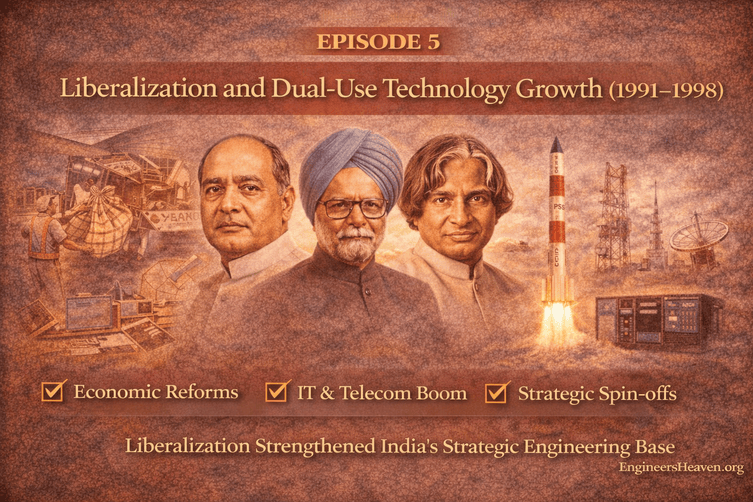
EPISODE 5 Liberalization and Dual-Use Technology Growth (1991–1998)
July 1991.
India faced a balance-of-payments crisis.
Foreign exchange reserves fell to the equivalent of two weeks of imports.
Gold was airlifted to secure emergency loans.
But from crisis emerged structural transformation.
This episode examines how economic liberalization reshaped India’s technological base — and indirectly strengthened strategic capability.
1️⃣ 1991 Economic Reforms: Structural Reset 24 July 1991 – New Industrial Policy Announced
Prime Minister:
P. V. Narasimha Rao
Finance Minister:
Manmohan Singh
Key reforms [1]:
Industrial licensing dismantled
Foreign direct investment liberalized
Public sector monopolies reduced
Trade barriers lowered
For the first time since independence, private capital gained systemic industrial space.
This mattered for defence — even if indirectly.
2️⃣ Rise of the IT Sector
1990s reforms catalyzed software exports and computing services.
Key corporate actors:
Infosys
Tata Consultancy Services
Wipro
Technology infrastructure expanded:
Software engineering ecosystem
Electronics manufacturing
Telecom modernization
The result:
Dual-use capability growth.
Software written for global corporations strengthened domestic simulation, encryption, and command systems capability.
3️⃣ Telecommunications Expansion 1994 – National Telecom Policy [2]
Telecom liberalization accelerated:
Private participation
Infrastructure modernization
Digital switching systems
Telecom networks later became critical for:
Secure communications
Satellite uplinks
Defence networking
Civilian growth strengthened strategic backbone.
4️⃣ Missile Program Maturation
The 1990s saw continued progress under IGMDP.
11 April 1999 – Agni-II (Beyond this episode's window, but built on 1990s groundwork)
Earlier tests in 1990s validated incremental advancements [3].
Leadership continuity:
A. P. J. Abdul Kalam
The engineering ecosystem now had:
Stronger private suppliers
Electronics manufacturing support
Materials industry depth
Liberalization improved supply chains.
5️⃣ Satellite and Launch Vehicle Progress
ISRO advanced:
PSLV development (first successful launch: 15 October 1994) [4]
IRS satellite systems
Civilian space capability increased:
Earth observation
Launch autonomy
Navigation groundwork
Dual-use implications were obvious.
6️⃣ Nuclear Continuity and Strategic Debate
Through the 1990s, nuclear capability remained undeclared but active.
Political leadership in 1998 would formalize it.
But groundwork — technical and industrial — was laid during 1991–1998.
Structural Assessment (1991–1998) Achievements
✔ Industrial liberalization
✔ IT ecosystem emergence
✔ Telecom infrastructure expansion
✔ PSLV success
✔ Strengthened missile supply chains
Limitations
✖ Defence production still largely state-controlled
✖ Advanced microelectronics dependency remained
✖ No formalized nuclear doctrine
Core Insight
1974–1991 built resilience under sanctions.
1991–1998 built economic velocity.
Liberalization did not directly target defence.
But it expanded:
Capital flow
Talent mobility
Industrial sophistication
Systems engineering capacity
When the next strategic assertion came, India was economically stronger.
That assertion defines Episode 6.
???? Reference List
[1] Government of India – New Industrial Policy (24 July 1991)
[2] National Telecom Policy (1994)
[3] DRDO Archives – IGMDP Progress Reports (1990s)
[4] ISRO – PSLV-C2 Success (15 October 1994)
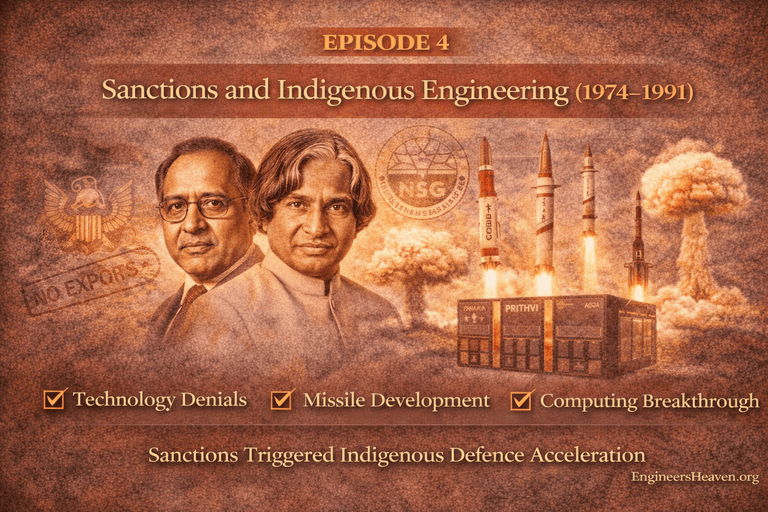 EPISODE 4 Sanctions and Indigenous Engineering (1974–1991)
18 May 1974 — Pokhran-I.
India demonstrated nuclear capability.
The global response was swift.
And punitive.
This episode examines how external sanctions unintentionally accelerated indigenous engineering capacity and forced India into self-reliant systems development.
1️⃣ Immediate Global Reaction (1974–1975)After the Pokhran-I test:
Canada suspended nuclear cooperation [1]
The United States tightened technology exports [2]
The Nuclear Suppliers Group was formed in 1975 specifically to regulate nuclear technology transfers after India’s test [3]
India entered a technology denial regime.
Critical imports restricted included:
Nuclear materials
Precision instrumentation
Advanced electronics
High-performance computing
The objective: isolate India technologically.
The result: internal capability development.
2️⃣ Nuclear Continuity Under PressureScientific leadership during post-1974 consolidation:
Raja Ramanna
Homi Sethna
They ensured:
Continuity of nuclear fuel cycle research
Reactor engineering progress
Indigenous heavy water production scaling
India expanded:
Heavy Water Board operations
Reactor design capability
Uranium processing autonomy
Sanctions created engineering compulsion.
3️⃣ Integrated Guided Missile Development Programme (IGMDP) Launched: 1983Approved under Prime Minister Indira Gandhi [4]
Scientific Director:
A. P. J. Abdul Kalam
Missile Systems Initiated:
Prithvi (Surface-to-Surface)
Agni (Ballistic)
Akash (Surface-to-Air)
Trishul
Nag
The IGMDP was not incremental.
It was systemic.
It forced domestic development of:
Solid propulsion systems
Guidance electronics
Composite materials
Re-entry vehicle technology
Sanctions blocked imports.
Engineering filled the gap.
4️⃣ High-Performance Computing DenialDuring the 1980s, India requested supercomputing access for weather modelling and defence simulation.
The United States denied Cray supercomputer exports [5].
Response:
India established the Centre for Development of Advanced Computing (C-DAC) in 1988 [6].
Result:
Development of the PARAM supercomputer series.
Technology denial catalyzed indigenous computing architecture.
5️⃣ Agni Technology Demonstrator 22 May 1989 – First Agni Test [7]Under A. P. J. Abdul Kalam’s leadership.
This test validated:
Re-entry heat shield design
Solid-fuel booster staging
Missile guidance integration
The Agni program marked India's entry into long-range deterrence capability.
6️⃣ Structural Assessment (1974–1991) Achievements✔ Indigenous missile ecosystem initiated
✔ Nuclear fuel cycle autonomy strengthened
✔ Supercomputing capability developed
✔ Electronics and materials research expanded
✔ Systems integration culture matured
✖ Electronics industry still underdeveloped
✖ Dependence on foreign propulsion technologies remained in aviation
✖ Industrial liberalization yet to occur
✖ Private sector defence participation negligible
1974 triggered sanctions.
Sanctions triggered necessity.
Necessity triggered indigenous engineering acceleration.
By 1991, India had:
Missile prototypes
Nuclear infrastructure
Indigenous computing capability
Structured defence R&D ecosystem
But it lacked:
Economic velocity
Industrial scale
Private sector dynamism
That changes in Episode 5.
???? Reference List[1] Government of Canada – Nuclear Cooperation Suspension (1974)
[2] U.S. Export Control Amendments (Post-1974 Nuclear Test)
[3] Nuclear Suppliers Group – Formation Records (1975)
[4] DRDO Archives – IGMDP Launch (1983)
[5] U.S. Technology Export Denial Records – Cray Supercomputer Case (1980s)
[6] C-DAC Official History – Establishment (1988)
[7] DRDO Missile Program Archives – Agni TD Test (22 May 1989)
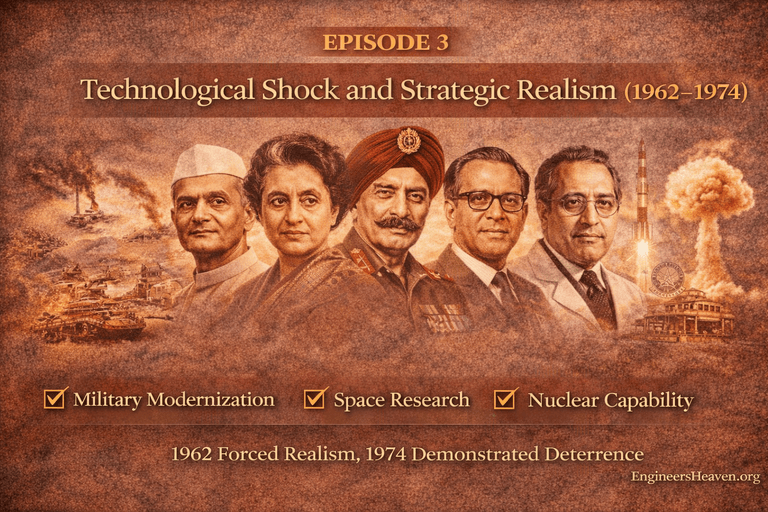
1962 did not just expose a military weakness.
It exposed a systems failure.
From 1962 to 1974, India transitioned from strategic idealism to strategic realism — integrating war experience, industrial acceleration, space research, and nuclear capability into a coherent national security framework.
This is the decade where engineering became geopolitical.
1️⃣ 1962: The Shock That Restructured Defence October–November 1962 – Sino-Indian War
(Official History of the 1962 War, Government of India) [1]
Political Leadership:
Jawaharlal Nehru
Defence Minister (until October 1962):
V. K. Krishna Menon
Failures exposed:
Border infrastructure deficit
High-altitude logistics weakness
Intelligence integration gaps
Air power underutilization
The lesson: institutions without operational readiness collapse under stress.
2️⃣ Structural Reforms After 1962 Yashwantrao B. Chavan Appointed Defence Minister (November 1962)
Yashwantrao Chavan initiated rapid military modernization [2]:
Expansion of mountain divisions
Accelerated ordnance production
Procurement reform
Strengthening of training doctrines
Defence spending increased significantly between 1962–1965 (Government Budget Records) [3].
Engineering began aligning with battlefield needs.
3️⃣ 1965 War: Tactical Recovery August–September 1965 – Indo-Pak War
(Official History, Ministry of Defence) [4]
Prime Minister:
Lal Bahadur Shastri
Military Leadership:
Gen. J. N. Chaudhuri
This conflict demonstrated improved mobilization and operational coherence compared to 1962.
However, dependence on imported equipment remained high.
Lesson: Tactical resilience improved; strategic autonomy still incomplete.
4️⃣ Indigenous Aerospace Effort – HF-24 Marut First Flight: 17 June 1961
Operational induction: mid-1960s [5]
Designed by German engineer Kurt Tank under HAL.
Though underpowered (engine limitations), the HF-24 Marut marked India’s first indigenous jet fighter project.
It revealed a structural gap: propulsion technology dependency.
5️⃣ Space as Strategic Engineering 1969 – Formation of ISRO
Founded by Vikram Sarabhai [6]
Sarabhai’s vision:
Space for development
Satellite communication
Remote sensing
Indigenous launch capability
Space engineering laid foundations for:
Ballistic trajectory understanding
Solid propulsion systems
Systems integration culture
Though civilian in doctrine, the technological spillover would later support strategic capability.
6️⃣ 1971 War: Integrated Military Confidence December 1971 – Indo-Pak War
(Official War History, Government of India) [7]
Prime Minister:
Indira Gandhi
Army Chief:
Sam Manekshaw
Outcome:
Creation of Bangladesh
Coordinated tri-service execution
Clear strategic objective
Engineering implications:
Improved logistics
Better communications systems
Coordinated command planning
1971 restored strategic confidence.
7️⃣ Nuclear Assertion – Pokhran-I 18 May 1974 – “Smiling Buddha” Test
(Pokhran, Rajasthan) [8]
Prime Minister:
Indira Gandhi
Scientific Leadership:
Raja Ramanna
Homi Sethna
India conducted a “peaceful nuclear explosion.”
This marked:
Entry into nuclear-capable states
Assertion of technological sovereignty
Trigger for future sanctions
The nuclear test was not sudden.
It was the culmination of two decades of atomic research architecture initiated under Bhabha.
Structural Assessment (1962–1974) Achievements
✔ Defence modernization post-1962
✔ Improved battlefield integration (1965 & 1971)
✔ Indigenous aerospace experimentation (HF-24)
✔ ISRO formation (1969)
✔ Nuclear demonstration (1974)
Limitations
✖ Propulsion dependency
✖ Electronics and avionics import reliance
✖ Early missile capability absent
✖ Industrial base not fully defence-integrated
Core Insight
1962 created urgency.
1965 restored balance.
1971 demonstrated strategic coordination.
1974 asserted nuclear capability.
Between 1962 and 1974, India transformed from an idealistic republic into a state aware of power, deterrence, and technological sovereignty.
This realism would trigger sanctions.
Sanctions would trigger indigenous engineering acceleration.
That is Episode 4.
???? Reference List
[1] Government of India – Official History of the 1962 Sino-Indian War
[2] Ministry of Defence Archives – Y. B. Chavan Reforms (1962–1965)
[3] Government Budget Documents (1962–1965 Defence Expenditure Increase)
[4] Ministry of Defence – Official History of the 1965 War
[5] HAL Archives – HF-24 Marut Program Records
[6] ISRO Official History – Establishment (1969)
[7] Government of India – Official History of the 1971 War
[8] Government of India – Pokhran-I Test Documentation (18 May 1974)
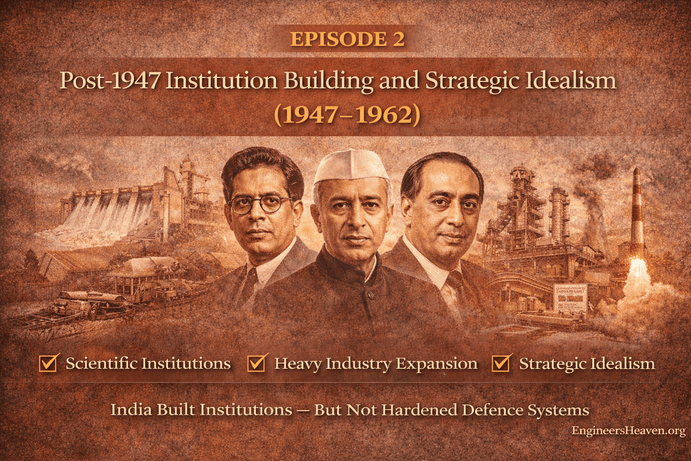
EPISODE 2 Post-1947 Institution Building and Strategic Idealism (1947–1962)
15 August 1947 — India became politically independent.
But sovereignty requires more than flags and constitutions.
It requires:
Scientific institutions
Industrial depth
Strategic clarity
Military preparedness
Between 1947 and 1962, India built powerful institutions — yet strategic idealism often outpaced military modernization.
1️⃣ Nehruvian Scientific StatecraftPrime Minister Jawaharlal Nehru viewed science as the foundation of modern India.
He famously called dams and laboratories the “temples of modern India.”
Key Institutional Milestones1948 – Atomic Energy Commission (AEC)
Chaired by Homi Jehangir Bhabha [1]
1954 – Department of Atomic Energy (DAE) [2]
1958 – Defence Research and Development Organisation (DRDO) [3]
These institutions created structured scientific governance within a young republic.
2️⃣ The Bhabha Nuclear VisionHomi Bhabha proposed a three-stage nuclear power program in the 1950s [4]:
Pressurized Heavy Water Reactors (PHWRs)
Fast Breeder Reactors
Thorium-based reactors
India possessed limited uranium but large thorium reserves.
Bhabha designed a long-term resource-based strategy decades ahead of global energy security debates.
3️⃣ Industrial Policy & Heavy Engineering ExpansionUnder the Second Five-Year Plan (1956–1961), architected by P. C. Mahalanobis, India emphasized:
Heavy machinery
Public sector steel plants
Infrastructure development
Major steel plants established with foreign collaboration:
Bhilai (USSR)
Rourkela (Germany)
Durgapur (UK)
(Planning Commission Records, 1956) [5]
Industrial depth expanded — but defence manufacturing integration remained limited.
4️⃣ DRDO Formation (1958)DRDO was created by merging:
Technical Development Establishment (TDEs)
Directorate of Technical Development and Production (DTDP)
[3]
Initial focus areas:
Armaments
Combat engineering
Military communications
However, funding and systems integration capacity were modest during this period.
5️⃣ Strategic Idealism & Panchsheel (1954)India signed the Panchsheel Agreement with China in 1954 [6].
Core principles:
Mutual respect
Non-aggression
Non-interference
India pursued Non-Alignment — balancing Cold War blocs without formal alliances.
Military modernization did not accelerate proportionately.
Strategic assessment underestimated Chinese infrastructure buildup in Tibet (Maxwell, 1970) [7].
6️⃣ The 1962 Sino-Indian War: Systemic Shock October–November 1962China launched coordinated offensives across:
Aksai Chin
NEFA (now Arunachal Pradesh)
Political Leadership:
Prime Minister Jawaharlal Nehru
Defence Minister:
V. K. Krishna Menon
(Official History of the 1962 War, Government of India) [8]
Engineering and structural weaknesses exposed:
Inadequate mountain warfare logistics
Insufficient high-altitude equipment
Poor intelligence integration
Weak air power utilization
1962 was not merely a battlefield defeat.
It was a systems failure.
Structural Assessment (1947–1962) Achievements✔ Creation of Atomic Energy Commission (1948)
✔ Establishment of DRDO (1958)
✔ Heavy industry expansion
✔ Institutional scientific governance
✔ Nuclear research roadmap
✖ Underinvestment in operational defence modernization
✖ Strategic overreliance on diplomacy
✖ Weak border infrastructure
✖ Limited integration between R&D and armed forces
1947–1962 was the era of institutional optimism.
India built laboratories, reactors, steel plants, and research councils.
But it did not yet build hardened defence systems aligned with geopolitical realities.
The 1962 war forced the transition from idealism to realism.
That transition defines Episode 3.
