User Ideas / Prospects

Contributors Who Made India a High-Technology Defence Nation (Beyond Manpower, Towards Engineering Sovereignty)
India’s defence strength rests on five engineering pillars:
Nuclear & Strategic Systems
Missile & Aerospace Engineering
Defence Electronics & Radar
Materials, Metallurgy & Manufacturing
Systems Integration & Institutions
1. Nuclear & Strategic Engineering Foundations Dr. Homi Jehangir Bhabha
Architect of India’s nuclear science and engineering ecosystem. Established the scientific, institutional, and ethical foundations for nuclear research, reactors, and strategic capability under extreme global pressure.
Dr. Raja Ramanna
A physicist-engineer who played a critical role in India’s nuclear weapons program. Known for balancing scientific rigor with national responsibility.
Dr. Anil Kakodkar
A nuclear engineer who strengthened reactor safety, indigenous reactor design, and long-term nuclear energy sustainability, particularly during sanctions.
2. Missile, Aerospace & Systems Engineering Dr. A. P. J. Abdul Kalam
Aerospace engineer and systems integrator. His contribution was not just missiles, but program management, indigenous design culture, and systems thinking across DRDO and ISRO.
Dr. V. K. Saraswat
Key figure in missile systems, guidance, control, and strategic deterrence technologies. Helped mature India’s missile programs into reliable operational systems.
Prof. Satish Dhawan
Aeronautical engineer who built India’s aerospace research culture and institutions, enabling both civilian space and defence applications.
3. Defence Electronics, Radar & Communication Systems Dr. Avinash Chander
Electronics and radar engineer who led the development of advanced missile systems and electronic warfare capabilities.
Dr. T. Tessy Thomas
A guidance and missile systems engineer, known for her work on Agni-class missiles. Represents the depth of control systems, navigation, and reliability engineering in Indian defence.
DRDO Electronics & Radar Engineering Teams (Collective Contribution)
Thousands of engineers working on:
AESA radars
secure communication systems
electronic warfare
surveillance and command systems
Their work defines modern warfare readiness, not visible firepower.
4. Materials, Metallurgy & Manufacturing Engineers (Often Ignored)
India’s defence reliability depends heavily on materials engineers who developed:
high-temperature alloys,
armor-grade steels,
composites,
stealth coatings,
propulsion materials.
Institutions like:
DMRL (Defence Metallurgical Research Laboratory)
HAL manufacturing divisions
Ordnance factories (now corporatized entities)
enabled production-scale engineering, not just prototypes.
5. Naval, Submarine & Marine Engineering Indian Naval Design Bureau Engineers
Responsible for:
indigenous warship design,
stealth frigates,
submarine systems integration.
This is one of the most complex engineering domains, involving:
hydrodynamics,
propulsion,
materials,
electronics,
and safety-critical systems.
6. The Invisible Backbone: Systems & Institution Builders
India’s defence capability exists because of engineers who:
wrote standards,
validated safety margins,
tested failure modes,
managed lifecycle maintenance,
and transferred knowledge across generations.
Institutions matter as much as individuals:
DRDO
BARC
ISRO (dual-use technologies)
HAL
BEL
Naval Design Bureau
Indigenous PSU and lab ecosystems
A Critical Clarification (Very Important)
India did not become strong because of:
imported weapons alone,
one-time breakthroughs,
or headline projects.
India became strong because of:
decades of engineering continuity,
indigenous problem-solving under denial regimes,
ethical responsibility in high-risk systems,
and engineers who worked knowing failure was not an option.
Closing Reflection
An army’s courage is timeless.
But an army’s effectiveness is engineered.
India stands strong today because thousands of engineers:
worked without visibility,
accepted lifelong accountability,
and treated defence engineering as a moral responsibility, not a career move.
This is nation-building through engineering.
Indian Republic Day Tribute
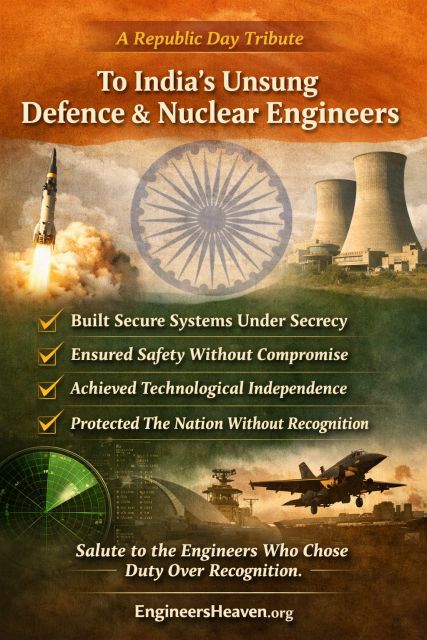
To India’s Unsung Defence and Nuclear Engineers
On Indian Republic Day, public memory often recalls soldiers, leaders, and visible symbols of national strength.
Far less visible are the engineers who ensured that India could stand independently, defend itself, and decide its own future.
This is a tribute to India’s unsung defence and nuclear engineers—men and women who worked in silence, under secrecy, sanctions, and immense pressure, not for recognition, but for national survival.
Engineering Without Applause
India’s defence and nuclear capabilities were not built in an era of:
open global collaboration,
easy access to technology,
or abundant resources.
They were built during:
technology denial regimes,
international sanctions,
limited industrial capacity,
and constant geopolitical pressure.
Every reactor, missile system, radar, submarine component, guidance system, and safety protocol had to be engineered under constraints, often reinvented from first principles.
This was not innovation for markets.
This was engineering for sovereignty.
Nuclear Engineers: Guardians of Energy and Deterrence
India’s nuclear engineers carried a dual responsibility:
Civil responsibility
safe power generation
reactor stability
radiation containment
long-term environmental responsibility
Strategic responsibility
credible deterrence
national security
technological self-reliance
Errors were not an option.
Failure was not public—it was existential.
Their success ensured:
India’s energy independence trajectory,
strategic autonomy,
and scientific credibility on the global stage.
Defence Engineers: Builders of Invisible Shields
Behind every:
missile test,
naval platform,
electronic warfare system,
surveillance radar,
or secure communication network
stands an army of engineers who:
calculated margins no one would ever see,
tested systems that must never fail,
and accepted accountability without visibility.
They worked knowing that:
if they succeeded, no one would notice;
if they failed, history would never forgive.
That is the highest burden of engineering responsibility.
Why They Remain Unsung
These engineers remain largely unknown because:
secrecy was mandatory,
credit was irrelevant,
and publicity was dangerous.
Their reward was not fame, wealth, or public applause.
Their reward was:
national safety,
institutional continuity,
and quiet professional pride.
A Republic Built on Engineering Integrity
India’s Republic is not sustained by symbols alone.
It is sustained by:
correctly calculated tolerances,
ethically followed safety protocols,
systems that work every day without headlines,
and engineers who placed duty above recognition.
This Republic Day, remembrance must extend beyond the visible.
Closing Reflection
Nations are defended not only by weapons,
but by engineers who ensure those systems never fail.
India’s unsung defence and nuclear engineers represent:
discipline over drama,
responsibility over recognition,
and engineering in its purest form.
This Republic stands, in part, because they chose silence over spotlight. Read More
