Episode 1: Pre-Independence Industrial and Scientific Foundations (c. 1850–1947) from Engineers Heaven's Idea / Prospect
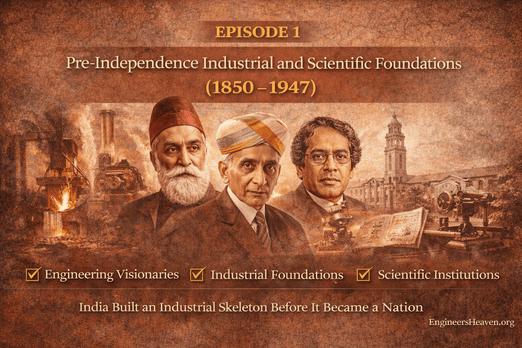
Episode 1: Pre-Independence Industrial and Scientific Foundations (c. 1850–1947)
(With embedded citation markers for direct publishing use)
Episode 1 — The Engineers Who Built Before the Nation Existed
Before 1947.
Before the Constitution.
Before sovereignty.
India already had engineers building the skeleton of a future nation.
This episode examines how industrialists, scientists, and institutional architects between 1850 and 1947 laid the structural, scientific, and industrial foundations that independent India would later inherit.
1️⃣ Industrial Modernity Under Colonial Constraint (1850s–1910s)
The British built railways and ports for extraction — but Indian engineers and industrialists learned from within that system.
Jamsetji Tata (1839–1904)
Founded Tata Iron and Steel Company (TISCO) in 1907 at Sakchi (later Jamshedpur) [1].
Commissioned India’s first integrated steel plant (production began 1912) [1].
Conceived the Indian Institute of Science (IISc) in 1898; established in 1909 in Bangalore [2].
Jamsetji Tata’s steel plant would later supply rails, defense materials, and heavy industrial inputs to independent India.
Without domestic steel, sovereignty remains theoretical.
Sir M. Visvesvaraya (1861–1962)
Designed the Krishna Raja Sagara (KRS) Dam (completed 1931) [3].
Introduced automatic sluice gates at Khadakwasla (1903) [3].
As Diwan of Mysore (1912–1918), promoted industrialization and technical education [3].
He institutionalized engineering discipline as a nation-building instrument — decades before political independence.
2️⃣ Scientific Institutionalization (1890s–1930s)
India’s scientific ecosystem did not begin in 1947. It matured under colonial constraints.
Jagadish Chandra Bose (1858–1937)
Demonstrated millimeter-wave radio transmission in 1895 [4].
Founded the Bose Institute in 1917 [4].
C. V. Raman (1888–1970)
Discovered the Raman Effect on 28 February 1928 [5].
Awarded Nobel Prize in Physics in 1930 [5].
These scientists established proof: Indians could generate frontier science, not merely import it.
3️⃣ Strategic Research Architecture Before Freedom (1930s–1947)
As global war intensified, the need for organized research became evident.
Council of Scientific and Industrial Research (CSIR)
Established 26 September 1942 under British India [6].
Spearheaded by Sir Shanti Swarup Bhatnagar (1894–1955) [6].
Bhatnagar structured CSIR into domain-specific laboratories — petroleum, chemicals, metallurgy, physics — forming the backbone of post-independence R&D.
4️⃣ Atomic Vision Before Atomic Sovereignty Homi Jehangir Bhabha (1909–1966)
Proposed nuclear research program to the Tata Trust in 1944 [7].
Founded the Tata Institute of Fundamental Research (TIFR) in 1945 [7].
TIFR later became the cradle of India’s nuclear and high-energy physics programs.
5️⃣ Engineering Nationalism Before Political Nationalism
By 1947, India already possessed:
An integrated steel plant (TISCO)
A premier science institute (IISc)
A structured research council (CSIR)
Foundational nuclear research infrastructure (TIFR)
Industrial engineering leadership (Visvesvaraya model)
Independence did not start from zero.
It inherited infrastructure built by engineers working under political limitation but with civilizational ambition.
Closing Reflection
Political independence occurred on 15 August 1947.
But engineering sovereignty had begun decades earlier.
The republic did not create engineers.
Engineers made the republic possible.

The Wall