engineersheaven's Idea / Prospect
1. Core Technical Designations (By Specialization)
Engineers often hold titles based on their specific area of expertise:- Structural Engineer: Designs and analyzes buildings, bridges, and other structures to ensure safety and stability.
- Geotechnical Engineer: Analyzes soil and rock properties to design foundations, retaining walls, and tunnels.
- Transportation/Traffic Engineer: Plans and maintains roads, railways, airports, and public transit systems.
- Water Resources Engineer: Manages water supply, drainage, irrigation networks, and flood control systems.
- Environmental Engineer: Focuses on waste management, pollution control, and sustainable infrastructure.
- Design Engineer: Uses CAD software to create technical blueprints and project models.
- Site Engineer: Oversees day-to-day operations at construction sites, ensuring plans and safety protocols are followed.
- Construction Manager: Manages the entire construction process, including budgets, timelines, and subcontractors.
- Quantity Surveyor: Estimates and manages the costs of materials, labor, and equipment.
- Quality Assurance/Quality Control (QA/QC) Engineer: Ensures all engineering processes and products meet required standards and regulations.
- Junior Engineer (JE): The entry-level role responsible for data collection, estimation, and site tests.
- Assistant Engineer (AE): Manages major projects and supervises technical staff.
- Executive Engineer (EE): Senior administrative and technical role with 8–10 years of experience.
- Chief Engineer / Engineer-in-Chief: Top-most ranks overseeing entire departments or states.
- Entry Level (0–2 years): Graduate Engineer Trainee (GET), Junior Engineer, or Assistant Design Engineer.
- Mid-Level (3–7 years): Project Engineer, Senior Design Engineer, or Structural Specialist.
- Senior/Leadership: Director of Engineering, Principal Engineer, VP of Civil Engineering, or Chief Civil Engineer.
1. What is structural design?
Answer:
Structural design is the process of analyzing and proportioning structural members so they can safely carry loads and transfer them to the foundation without failure or excessive deformation, as per relevant codes.
2. What are the main loads considered in structural design?
Answer:
Dead load
Live load
Wind load
Earthquake load
Snow load (where applicable)
3. Difference between analysis and design?
Answer:
Analysis: Finding internal forces (bending moment, shear, axial force)
Design: Providing member size and reinforcement to resist those forces safely
4. What is limit state design?
Answer:
Limit State Design ensures safety against:
Limit state of collapse (strength failure)
Limit state of serviceability (deflection, cracking, vibration)
5. Which code is used for RCC design in India?
Answer:
IS 456: 2000 – Code of practice for plain and reinforced concrete.
6. What is characteristic strength of concrete?
Answer:
The strength below which not more than 5% of test results are expected to fall.
Example: M20 → 20 MPa characteristic compressive strength.
7. What is partial safety factor?
Answer:
A factor applied to loads and material strength to account for uncertainties in loading, material properties, and workmanship.
8. What is working stress method?
Answer:
A design method where stresses under service loads are limited to permissible values.
(It is older and less economical than limit state method.)
9. Difference between one-way and two-way slab?
Answer:
One-way slab: Load carried mainly in one direction (L/B ≥ 2)
Two-way slab: Load carried in both directions (L/B < 2)
10. What is effective depth?
Answer:
Distance from the compression face to the center of tension reinforcement.
11. Why is minimum reinforcement provided?
Answer:
To:
Control cracking
Improve ductility
Prevent sudden brittle failure
12. What is neutral axis?
Answer:
The line in a cross-section where stress changes from compression to tension and strain is zero.
13. What is under-reinforced section?
Answer:
A section where steel yields before concrete crushes, giving ductile failure.
(It is preferred in design.)
14. Why over-reinforced sections are not allowed?
Answer:
Because they fail suddenly by concrete crushing, without warning.
15. What is shear failure?
Answer:
Failure caused by diagonal tension cracks, usually sudden and brittle.
16. Why stirrups are provided in beams?
Answer:
Resist shear forces
Hold main reinforcement in position
Improve ductility
17. Difference between short and long column?
Answer:
Short column: Fails by crushing
Long column: Fails by buckling
18. What is slenderness ratio?
Answer:
Ratio of effective length to least lateral dimension of column.
19. Why lateral ties are provided in columns?
Answer:
Prevent buckling of longitudinal bars
Confine concrete
Improve ductility
20. What is development length?
Answer:
The length required to develop full strength of reinforcement through bond with concrete.
21. Why is cover provided?
Answer:
Protect steel from corrosion
Ensure fire resistance
Provide proper bond
22. What is load combination?
Answer:
Combination of different loads multiplied by safety factors to consider worst-case scenarios.
23. Difference between fixed and hinged support?
Answer:
Fixed: Restrains rotation and translation
Hinged: Allows rotation but restrains translation
24. What is indeterminate structure?
Answer:
A structure where reactions cannot be found using only equilibrium equations.
25. What is stiffness?
Answer:
Resistance offered by a structure or member against deformation.
26. What is deflection control and why is it important?
Answer:
To ensure:
Comfort of occupants
No damage to finishes
Proper serviceability
27. What is creep and shrinkage?
Answer:
Creep: Time-dependent deformation under sustained load
Shrinkage: Volume reduction due to moisture loss
28. What is ductility?
Answer:
Ability of a structure to undergo large deformation before failure, especially important in earthquakes.
29. What is load path?
Answer:
The route by which loads travel from slab → beam → column → foundation → soil.
30. What software are used for structural analysis?
Answer:
ETABS, STAAD Pro, SAFE, SAP2000
(But results must be verified manually.)
When interviewing for a Structural Design role, the focus shifts from general site execution to your understanding of mechanics, load paths, and code compliance (like IS 456, IS 800, or ACI codes).
Here are the most frequently asked technical questions and how to answer them:
1. Fundamental Mechanics & Structural AnalysisThese test your "engineering intuition" before you ever touch a software.
Q: What is the difference between a Fixed Support and a Pinned Support?
Answer: A Fixed support resists three forces: vertical, horizontal, and moment (rotation). A Pinned (Hinged) support resists vertical and horizontal forces but allows rotation (zero moment).
Q: Explain the concept of "Ductility" in a structure.
Answer: Ductility is the ability of a structure to undergo significant plastic deformation before failure. In seismic (earthquake) design, we want ductile structures so they dissipate energy and give occupants time to escape before a collapse.
Q: Draw the Shear Force Diagram (SFD) and Bending Moment Diagram (BMD) for a simply supported beam with a UDL.
Answer: The SFD will be a linear sloping line passing through zero at the center. The BMD will be a parabolic curve with the maximum value at the center (M=8wL2).
Q: Why is steel used as reinforcement in concrete? Why not other metals?
Answer: Concrete is strong in compression but weak in tension; steel provides the necessary tensile strength. Steel is specifically chosen because its Coefficient of Thermal Expansion is nearly identical to concrete, preventing internal stresses during temperature changes.
Q: What is the difference between "Working Stress Method" (WSM) and "Limit State Method" (LSM)?
Answer: WSM is a deterministic approach that assumes materials behave elastically and uses a high factor of safety on material strength. LSM is a probabilistic approach that considers safety factors for both loads (partial safety factors) and material strength, making it more economical and realistic.
Q: What is "Development Length" (Ld)?
Answer: It is the minimum length of a rebar that must be embedded in concrete to ensure a sufficient bond between the two, preventing the bar from "pulling out" when under tension.
Q: What is a "Slenderness Ratio" and why does it matter?
Answer: It is the ratio of the effective length of a column to its least radius of gyration (λ=rLeff). A higher ratio means the column is more likely to fail by buckling rather than crushing.
Q: Why are I-sections most commonly used for beams?
Answer: In bending, the maximum stress occurs at the top and bottom fibers. The I-section concentrates the material (flanges) at these extreme fibers where the stress is highest, making it highly efficient for resisting moments.
Q: In ETABS or STAAD.Pro, what is a "Diaphragm"?
Answer: A diaphragm is a structural element (usually the floor slab) that transmits lateral loads (wind or earthquake) to the vertical resisting elements like columns and shear walls.
Q: What is the purpose of "Clear Cover" vs. "Nominal Cover"?
Answer: Clear Cover is the distance from the concrete surface to the outer surface of the reinforcement (stirrup). Nominal Cover (per IS 456) is the design requirement to protect steel against corrosion and fire.
| Element | Minimum Grade of Concrete | Minimum Steel (as per IS 456) |
| Slab | M20 | 0.12% (HYSD) or 0.15% (Mild Steel) |
| Column | M20 | 0.8% (Min) to 6% (Max) of Gross Area |
| Beam | M20 | Based on As=fy0.85bd |
Contributors Who Made India a High-Technology Defence Nation (Beyond Manpower, Towards Engineering Sovereignty)
India’s defence strength rests on five engineering pillars:
Nuclear & Strategic Systems
Missile & Aerospace Engineering
Defence Electronics & Radar
Materials, Metallurgy & Manufacturing
Systems Integration & Institutions
1. Nuclear & Strategic Engineering Foundations Dr. Homi Jehangir Bhabha
Architect of India’s nuclear science and engineering ecosystem. Established the scientific, institutional, and ethical foundations for nuclear research, reactors, and strategic capability under extreme global pressure.
Dr. Raja Ramanna
A physicist-engineer who played a critical role in India’s nuclear weapons program. Known for balancing scientific rigor with national responsibility.
Dr. Anil Kakodkar
A nuclear engineer who strengthened reactor safety, indigenous reactor design, and long-term nuclear energy sustainability, particularly during sanctions.
2. Missile, Aerospace & Systems Engineering Dr. A. P. J. Abdul Kalam
Aerospace engineer and systems integrator. His contribution was not just missiles, but program management, indigenous design culture, and systems thinking across DRDO and ISRO.
Dr. V. K. Saraswat
Key figure in missile systems, guidance, control, and strategic deterrence technologies. Helped mature India’s missile programs into reliable operational systems.
Prof. Satish Dhawan
Aeronautical engineer who built India’s aerospace research culture and institutions, enabling both civilian space and defence applications.
3. Defence Electronics, Radar & Communication Systems Dr. Avinash Chander
Electronics and radar engineer who led the development of advanced missile systems and electronic warfare capabilities.
Dr. T. Tessy Thomas
A guidance and missile systems engineer, known for her work on Agni-class missiles. Represents the depth of control systems, navigation, and reliability engineering in Indian defence.
DRDO Electronics & Radar Engineering Teams (Collective Contribution)
Thousands of engineers working on:
AESA radars
secure communication systems
electronic warfare
surveillance and command systems
Their work defines modern warfare readiness, not visible firepower.
4. Materials, Metallurgy & Manufacturing Engineers (Often Ignored)
India’s defence reliability depends heavily on materials engineers who developed:
high-temperature alloys,
armor-grade steels,
composites,
stealth coatings,
propulsion materials.
Institutions like:
DMRL (Defence Metallurgical Research Laboratory)
HAL manufacturing divisions
Ordnance factories (now corporatized entities)
enabled production-scale engineering, not just prototypes.
5. Naval, Submarine & Marine Engineering Indian Naval Design Bureau Engineers
Responsible for:
indigenous warship design,
stealth frigates,
submarine systems integration.
This is one of the most complex engineering domains, involving:
hydrodynamics,
propulsion,
materials,
electronics,
and safety-critical systems.
6. The Invisible Backbone: Systems & Institution Builders
India’s defence capability exists because of engineers who:
wrote standards,
validated safety margins,
tested failure modes,
managed lifecycle maintenance,
and transferred knowledge across generations.
Institutions matter as much as individuals:
DRDO
BARC
ISRO (dual-use technologies)
HAL
BEL
Naval Design Bureau
Indigenous PSU and lab ecosystems
A Critical Clarification (Very Important)
India did not become strong because of:
imported weapons alone,
one-time breakthroughs,
or headline projects.
India became strong because of:
decades of engineering continuity,
indigenous problem-solving under denial regimes,
ethical responsibility in high-risk systems,
and engineers who worked knowing failure was not an option.
Closing Reflection
An army’s courage is timeless.
But an army’s effectiveness is engineered.
India stands strong today because thousands of engineers:
worked without visibility,
accepted lifelong accountability,
and treated defence engineering as a moral responsibility, not a career move.
This is nation-building through engineering.
Indian Republic Day Tribute
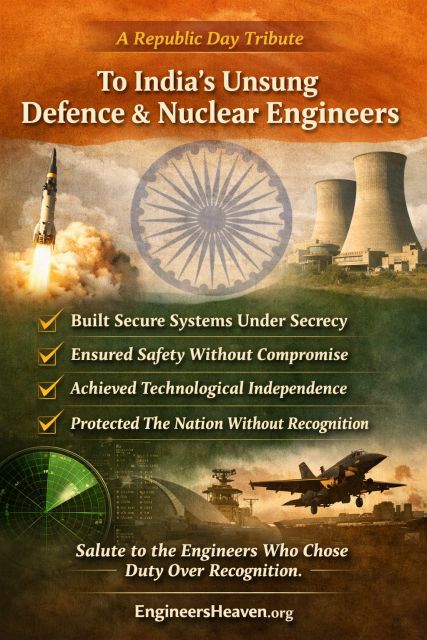
To India’s Unsung Defence and Nuclear Engineers
On Indian Republic Day, public memory often recalls soldiers, leaders, and visible symbols of national strength.
Far less visible are the engineers who ensured that India could stand independently, defend itself, and decide its own future.
This is a tribute to India’s unsung defence and nuclear engineers—men and women who worked in silence, under secrecy, sanctions, and immense pressure, not for recognition, but for national survival.
Engineering Without Applause
India’s defence and nuclear capabilities were not built in an era of:
open global collaboration,
easy access to technology,
or abundant resources.
They were built during:
technology denial regimes,
international sanctions,
limited industrial capacity,
and constant geopolitical pressure.
Every reactor, missile system, radar, submarine component, guidance system, and safety protocol had to be engineered under constraints, often reinvented from first principles.
This was not innovation for markets.
This was engineering for sovereignty.
Nuclear Engineers: Guardians of Energy and Deterrence
India’s nuclear engineers carried a dual responsibility:
Civil responsibility
safe power generation
reactor stability
radiation containment
long-term environmental responsibility
Strategic responsibility
credible deterrence
national security
technological self-reliance
Errors were not an option.
Failure was not public—it was existential.
Their success ensured:
India’s energy independence trajectory,
strategic autonomy,
and scientific credibility on the global stage.
Defence Engineers: Builders of Invisible Shields
Behind every:
missile test,
naval platform,
electronic warfare system,
surveillance radar,
or secure communication network
stands an army of engineers who:
calculated margins no one would ever see,
tested systems that must never fail,
and accepted accountability without visibility.
They worked knowing that:
if they succeeded, no one would notice;
if they failed, history would never forgive.
That is the highest burden of engineering responsibility.
Why They Remain Unsung
These engineers remain largely unknown because:
secrecy was mandatory,
credit was irrelevant,
and publicity was dangerous.
Their reward was not fame, wealth, or public applause.
Their reward was:
national safety,
institutional continuity,
and quiet professional pride.
A Republic Built on Engineering Integrity
India’s Republic is not sustained by symbols alone.
It is sustained by:
correctly calculated tolerances,
ethically followed safety protocols,
systems that work every day without headlines,
and engineers who placed duty above recognition.
This Republic Day, remembrance must extend beyond the visible.
Closing Reflection
Nations are defended not only by weapons,
but by engineers who ensure those systems never fail.
India’s unsung defence and nuclear engineers represent:
discipline over drama,
responsibility over recognition,
and engineering in its purest form.
This Republic stands, in part, because they chose silence over spotlight. Read More
Although globally known, Prof. Raj Reddy’s work is often cited without recognizing its engineering discipline. His research in artificial intelligence focused not on hype but on real-world deployment, especially in speech recognition, human–computer interaction, and AI systems that could operate under uncertainty.
Why He Matters to Computer EngineersTreated AI as a systems engineering problem, not a theoretical exercise
Focused on accessibility, multilingual computing, and societal applications
Demonstrated how advanced computing research can coexist with public responsibility
His work reminds engineers that cutting-edge computing must still obey reliability, usability, and accountability.
2. Prof. Vijay Bhatkar – Architect of Indigenous SupercomputingWhen India faced technological denial regimes, Prof. Vijay Bhatkar led the development of the PARAM supercomputer, proving that computational sovereignty is an engineering problem—not a political slogan.
Engineering SignificanceDesigned parallel computing architectures under severe resource constraints
Built indigenous software stacks and compiler ecosystems
Trained a generation of system-level computer engineers
PARAM was not about raw speed—it was about engineering resilience and self-reliance.
3. Prof. V. Rajaraman – Father of Computer Science Education in IndiaBefore startups, before outsourcing, before cloud computing—there was infrastructure for thinking. Prof. V. Rajaraman built that foundation.
Contributions Often OverlookedDesigned India’s earliest computer science curricula
Authored textbooks that emphasized clarity, logic, and discipline
Advocated ethical responsibility long before it became fashionable
He shaped how generations of engineers think, not just what they code.
4. Sam Pitroda (Technical Phase) – Telecom and Digital Infrastructure EngineeringWhile later associated with policy, Pitroda’s early work was deeply engineering-driven, particularly in large-scale communication systems.
Computer Engineering RelevanceDesigned scalable switching and communication architectures
Focused on robustness in low-resource, high-noise environments
Bridged hardware, software, and network engineering
His early work shows how computing systems must adapt to social realities, not ideal lab conditions.
Indian Contributors to Core Computing and Internet Infrastructure 5. Abhay Bhushan – Architect of Internet Data ExchangeAbhay Bhushan authored RFC 114, which defined the File Transfer Protocol (FTP). FTP became one of the earliest practical mechanisms for sharing data across networked systems and laid the groundwork for collaborative computing.
His contribution represents the essence of early computer engineering:
solving real technical constraints,
creating interoperable systems,
and prioritizing functionality over monetization.
Without such protocol-level work, the modern internet economy would not exist.
6. Ram Mohan – Guardian of Internet Stability (Internet Hall of Fame Inductee)Ram Mohan’s work focused on the Domain Name System (DNS)— one of the most critical and fragile components of the internet.
Through leadership at Afilias and participation in global internet governance bodies such as ICANN and IETF, his contributions strengthened:
DNS security,
operational resilience,
and global coordination.
This is computer engineering at its most responsible: protecting infrastructure used by billions, with zero margin for error and little public visibility.
7. Dr. Shrinivas Ramani – Builder of India’s Early Computing EcosystemDr. Shrinivas Ramani was a pioneer of computer science and networking in India. He played a foundational role in:
establishing early computer networks,
advancing computing education,
and connecting Indian research institutions to global computing communities.
His impact was not a product or a platform, but capacity building— enabling generations of Indian engineers to participate meaningfully in computing research and systems development.
Global Contributors Who Defined the Engineering Foundations
Dennis Ritchie
Co-creator of the C programming language and UNIX. His work underpins operating systems, embedded systems, and infrastructure software globally. Modern computing stability owes more to Ritchie than to any visible tech celebrity.
Ken Thompson
Architect of UNIX and contributor to programming language design. His engineering philosophy emphasized simplicity, robustness, and long-term maintainability.
Edsger W. Dijkstra
Introduced disciplined thinking into software engineering—structured programming, correctness, and reasoning. His work directly counters today’s culture of careless scalability.
Barbara Liskov
Her contributions to data abstraction, programming language design, and the Liskov Substitution Principle shaped how reliable software systems are built and reasoned about.
Niklaus Wirth
Creator of Pascal and Modula. Advocated clarity, discipline, and educational rigor in programming—values increasingly absent in fast-paced software markets.
Beyond named individuals, computer engineering is sustained by:
compiler engineers
kernel and OS developers
network protocol designers
database system architects
firmware and embedded systems engineers
standards committee contributors
Their work rarely appears in media narratives, yet entire economies depend on their correctness.
Why These Contributors Matter in This SeriesThis series deliberately highlights contributors who:
built systems instead of brands
prioritized correctness over speed
valued responsibility over recognition
treated computing as public infrastructure, not spectacle
Understanding their mindset is more important than memorizing their biographies.
Final ReflectionComputer engineering progresses not through disruption alone, but through accumulated correctness.
Every stable system you rely on today exists because someone chose:
discipline over shortcuts
accountability over applause
engineering over storytelling
That is the professional lineage this series invites you to join.
Ethics in computer engineering is often reduced to:
compliance checklists,
legal disclaimers,
or abstract moral lectures.
This is a mistake.
In the modern era, ethics is not separate from engineering quality. Ethical failures almost always begin as technical decisions:
what to optimize,
what to ignore,
what to hide,
and who bears the risk.
This episode defines ethical principles as operational engineering rules, not philosophical ideals.
Principle 1: Accountability Cannot Be DelegatedA computer engineer is responsible for the systems they design, deploy, or maintain.
Responsibility does not disappear because:
requirements came from management,
deadlines were tight,
or tools behaved unexpectedly.
If you understand a risk and proceed anyway, you own the outcome.
Ethical engineers:
document known risks,
raise objections formally,
and refuse unsafe shortcuts when harm is likely.
In critical systems, speed is never neutral.
Rushing deployment without:
adequate testing,
failure-mode analysis,
rollback mechanisms,
transfers risk from the organization to society.
Ethical engineering prioritizes:
predictable behavior,
graceful failure,
and human override.
Complexity should never be used as a shield.
Ethical engineers avoid:
intentionally opaque algorithms,
undocumented decision logic,
misleading dashboards and metrics.
Transparency means:
explainable system behavior,
traceable decisions,
and auditability.
If a system cannot be reasonably explained, it should not control critical outcomes.
Principle 4: Data Belongs to People, Not PlatformsData is not an unlimited resource. It represents real human lives.
Ethical data handling requires:
informed consent,
minimal collection,
secure storage,
limited retention.
Designing systems that exploit user ignorance is an ethical failure, even if it is legal.
Principle 5: Bias Awareness Is a Technical ResponsibilityBias is not an abstract social problem. It is a data and design problem.
Ethical engineers:
question training data,
test for uneven outcomes,
monitor systems post-deployment.
Claiming neutrality does not remove responsibility.
Principle 6: Refusal Is a Professional SkillNot all projects deserve engineering effort.
Ethical engineers must be prepared to:
refuse unsafe implementations,
exit unethical projects,
or escalate concerns despite career risk.
Professional integrity sometimes requires saying no.
Principle 7: Long-Term Impact Over Short-Term MetricsOptimization choices shape society.
Systems optimized solely for:
engagement,
growth,
or profit
often externalize harm.
Ethical engineering evaluates:
downstream effects,
misuse potential,
and long-term societal cost.
Incompetence causes harm.
Accepting work beyond your capability without:
seeking help,
learning rigorously,
or setting boundaries
is ethically irresponsible.
Ethical engineers invest continuously in competence.
Ethical Responsibility in the Indian ContextIn India, engineers often operate in environments with:
weak enforcement,
high pressure to deliver,
low public technical literacy.
This increases responsibility, not reduces it.
Engineers become the last line of defensebetween technology and societal harm.
Ethics as Professional IdentityEthics is not about being idealistic. It is about being trustworthy under pressure.
Computer engineers increasingly shape:
governance,
markets,
infrastructure,
and public life.
Without ethical grounding, technical excellence becomes dangerous.
ClosingThe future of computer engineering will not be judged only by innovation.
It will be judged by:
safety,
fairness,
accountability,
and trust.
Ethical principles are not optional values. They are engineering requirements.
This concludes the ethics arc of the Computer Engineering series.
Computer engineering was once viewed as a neutral, technical discipline. That assumption is no longer valid.
Today, software systems:
decide access to services,
influence public opinion,
control infrastructure,
manage personal data,
and increasingly automate decision-making.
When ethics fail in computer engineering, the damage is often invisible, scalable, and irreversible.
This article examines how corruption, negligence, and ethical shortcuts in computer engineering have created real harm, especially in societies with weak accountability mechanisms.
What Corruption Means in Computer EngineeringCorruption in computer engineering is rarely about bribes alone. It manifests as:
intentional design manipulation,
data misuse for profit or power,
deliberate opacity in algorithms,
negligence masked as innovation,
compliance theater without responsibility.
Unlike traditional corruption, digital corruption scales instantly and silently.
Structural Reasons Ethical Failures Are Increasing 1. Speed Over SafetyModern tech rewards:
rapid deployment,
growth metrics,
and market capture.
Security, testing, and societal impact are treated as delays — not obligations.
2. Asymmetric Power Between Engineers and UsersUsers:
do not understand systems,
cannot audit algorithms,
and cannot realistically opt out.
This imbalance creates fertile ground for abuse.
3. Profit-Driven ArchitectureMany systems are intentionally designed to:
maximize engagement,
extract data,
lock users in.
Ethical harm is often a feature, not a bug.
Major Ethical Failures in Computer Engineering 1. Data Exploitation and Privacy ViolationsExamples include:
unauthorized data harvesting,
dark-pattern consent designs,
surveillance-driven platforms.
Impact:
loss of privacy,
behavioral manipulation,
erosion of trust.
Biased data and opaque models have led to:
unfair hiring filters,
discriminatory credit scoring,
unequal access to services.
The excuse of “model behavior” hides human responsibility.
3. Unsafe Automation and AI MisuseAutomation failures include:
untested AI in critical decision systems,
overreliance on predictive models,
absence of human override mechanisms.
Consequences range from economic harm to loss of life.
4. Security Negligence and Silent BreachesWeak security practices have caused:
massive data leaks,
infrastructure compromises,
national security risks.
Often disclosed only after irreversible damage.
Indian Context: Why the Risk Is HigherIn India:
digital adoption is rapid,
regulatory enforcement is uneven,
public awareness is limited.
This combination allows unethical systems to scale faster than safeguards.
Examples include:
insecure public digital platforms,
misuse of citizen data,
poorly audited private systems handling critical information.
Ethical harm is rarely caused by "bad people" alone. It often results from engineers who:
ignore long-term impact,
defer responsibility upward,
prioritize deadlines over safety,
hide behind job roles.
Silence is participation.
For computer engineers, employment has traditionally been portrayed as the only legitimate career outcome. However, rising competition, external control of hiring cycles, and increasing automation make it essential to discuss self-employment as a parallel and respectable engineering path.
Self-employment is not an escape from engineering rigor. It is a transition from shared responsibility to direct accountability.
This episode follows the same practical structure used in other engineering series: options, skills, budget, and feasibility.
Major Self-Employment Options for Computer Engineers 1. Engineering Services and Independent ConsultingWhat it is:Providing specialized technical services to organizations that lack in-house expertise.
Examples:
backend system stabilization
performance optimization
cloud cost and infrastructure management
cybersecurity audits for SMEs
legacy software modernization
Why it works:Businesses pay to reduce risk, downtime, and inefficiency — not for flashy features.
2. Small-Scale Software Products and ToolsWhat it is:Building narrowly focused software that solves a specific operational problem.
Examples:
internal dashboards
automation scripts
compliance and reporting tools
scheduling, billing, or monitoring utilities
Why it works:Small user bases with real pain points create stable, long-term revenue without venture funding.
3. Infrastructure and IT Operations for Local BusinessesWhat it is:Designing, deploying, and maintaining computing infrastructure for small and medium enterprises.
Examples:
server setup and maintenance
backup and disaster recovery systems
secure networking
email, storage, and access control systems
Why it works:This work is essential, recurring, and poorly served by large tech companies.
4. Hardware–Software and IoT-Based SolutionsWhat it is:Developing systems that integrate sensors, devices, and software to solve real-world problems.
Examples:
energy monitoring systems
agricultural automation
logistics and asset tracking
manufacturing process monitoring
Why it works:Physical-world problems require engineering reliability, not software hype.
Skills Required for Independent Computer EngineersIndependent engineers must combine technical depth with operational capability.
Core Technical Skillsstrong fundamentals (OS, networks, databases)
system design and debugging
secure coding practices
infrastructure and deployment understanding
documentation and communication
requirement clarification
maintenance planning
failure handling and incident response
basic costing and pricing
client communication
scope definition
ethical decision-making
Most self-employment paths in computer engineering have low capital requirements.
Typical Initial Needsreliable computer system
internet connectivity
open-source development tools
basic cloud or hosting expenses
budgets vary by geography, property availability, and cost of living
hardware-based solutions require additional capital
regulatory or compliance needs may add costs
In most cases, time and competenceare larger investments than money.
Making Self-Employment Feasible as an Individual Step 1: Start While Employed or StudyingReduce risk by validating skills and demand before full commitment.
Step 2: Specialize NarrowlyGeneralists struggle. Specialists survive.
Step 3: Solve One Real Problem RepeatedlyConsistency builds reputation faster than diversification.
Step 4: Build Trust Through ReliabilityRepeat clients matter more than rapid scaling.
Step 5: Avoid Hype-Driven ExpansionSlow, sustainable growth preserves engineering integrity.
Risks and RealitiesSelf-employment exposes:
technical weaknesses
ethical shortcuts
poor communication
Failures occur faster — but learning is deeper.
Closing PerspectiveSelf-employment in computer engineering is not about independence from work. It is about ownership of engineering responsibility.
Engineers who combine:
understanding,
execution,
skills,
and ethics
can build sustainable, respected careers beyond job markets.
This completes the Computer Engineering series arc.
Industries do not operate on philosophy alone. They operate on:
productivity,
robustness,
reliability,
and accountable execution.
AI and automation are powerful accelerators, but 100% automation is still a fantasy. Most real-world systems:
are incomplete,
operate under uncertainty,
involve legacy components,
and require human judgment at critical points.
This article exists to restore balance: understanding guides direction, skills deliver outcomes.
Why Skills Still Decide EmployabilityEven in an AI-assisted world:
systems must be designed,
tools must be configured,
failures must be diagnosed,
and responsibility must be owned.
AI can assist execution, but it cannot:
take legal responsibility,
guarantee safety,
understand organizational constraints,
or absorb accountability for failure.
That burden still rests on engineers.
The Difference Between Surface Skills and Engineering SkillsNot all skills are equal.
Surface skills:
memorizing syntax,
copying tutorials,
stacking certificates,
chasing tools without context.
These decay rapidly.
Engineering skills:
debugging under uncertainty,
reasoning about performance and failure,
understanding trade-offs,
working with incomplete information.
Core Skill Pillars for Computer Engineers
1. Foundational Technical Subjects (Non‑Negotiable)
Regardless of specialization, every computer engineer must have working competence in:
data structures and algorithms (for reasoning, not interviews),
operating systems fundamentals,
computer networks basics,
databases and data handling,
basic computer architecture.
These subjects enable engineers to understand whysystems behave the way they do.
2. Software Engineering Skills
Practical software competence includes:
reading and modifying large codebases,
writing testable and maintainable code,
version control discipline (Git workflows),
debugging production failures,
performance profiling.
Tools to master (conceptually, not superficially):
Git and collaborative workflows
Debuggers and profilers
Build systems and dependency managers
Logging and monitoring tools
Frameworks change. Engineering habits persist.
3. Systems and Infrastructure Skills
Modern computing runs on infrastructure.
Engineers must be comfortable with:
Linux environments,
deployment pipelines,
containerization concepts,
basic cloud architecture,
reliability and uptime thinking.
Key tool categories:
Linux command line and system utilities
Containers and orchestration (concept-level mastery)
CI/CD pipelines
Monitoring and alerting systems
These skills separate hobbyists from professionals.
4. Hardware, Embedded, and Interface Skills
Even for software-focused engineers, hardware awareness matters.
Practical exposure should include:
microcontrollers and sensors,
device–software communication,
timing and resource constraints,
power and thermal considerations.
This domain builds respect for physical reality — something pure software often ignores.
5. Problem-Solving Under Constraints
Real engineering problems include:
incomplete requirements,
budget limits,
time pressure,
legacy decisions.
Engineers must practice:
making trade-offs,
documenting assumptions,
defending decisions technically.
This is where skills become expertise.
How AI Fits Into Skill Development (Without Replacing It)AI should be treated as:
a productivity multiplier,
a debugging assistant,
a learning accelerator.
Not as:
a substitute for thinking,
a replacement for responsibility.
Engineers who rely blindly on AI tools lose diagnostic ability — and eventually relevance.
Skill Depth Over Skill BreadthThe modern mistake is excessive breadth.
It is better to:
master fewer tools deeply,
understand their failure modes,
and apply them across problems.
Depth compounds. Breadth dilutes.
Why This Article Matters for Indian EngineersIndia’s advantage is not proprietary platforms. It is:
execution capability,
adaptability,
and engineering discipline.
Those advantages survive AI disruption — but only when skills are real, practiced, and accountable.
What This Article Should ChangeFrom:
“Which tool should I learn next?”
To:
“Which skill makes me reliable when systems fail?”
That question defines professional maturity.
ClosingUnderstanding gives direction. Skills deliver value.
In modern computer engineering, both are mandatory.
The next article will move beyond employment into self‑employment, independent practice, and small‑scale engineering ventures, where skills and understanding are tested directly by reality.
